
Last updated September 20, 2026
Full 25-point door and opener safety check with every visit - springs, cables, rollers, tracks, and your LiftMaster or Chamberlain opener included
You get a price before we start. It does not change when the truck arrives.
 Before
 After
After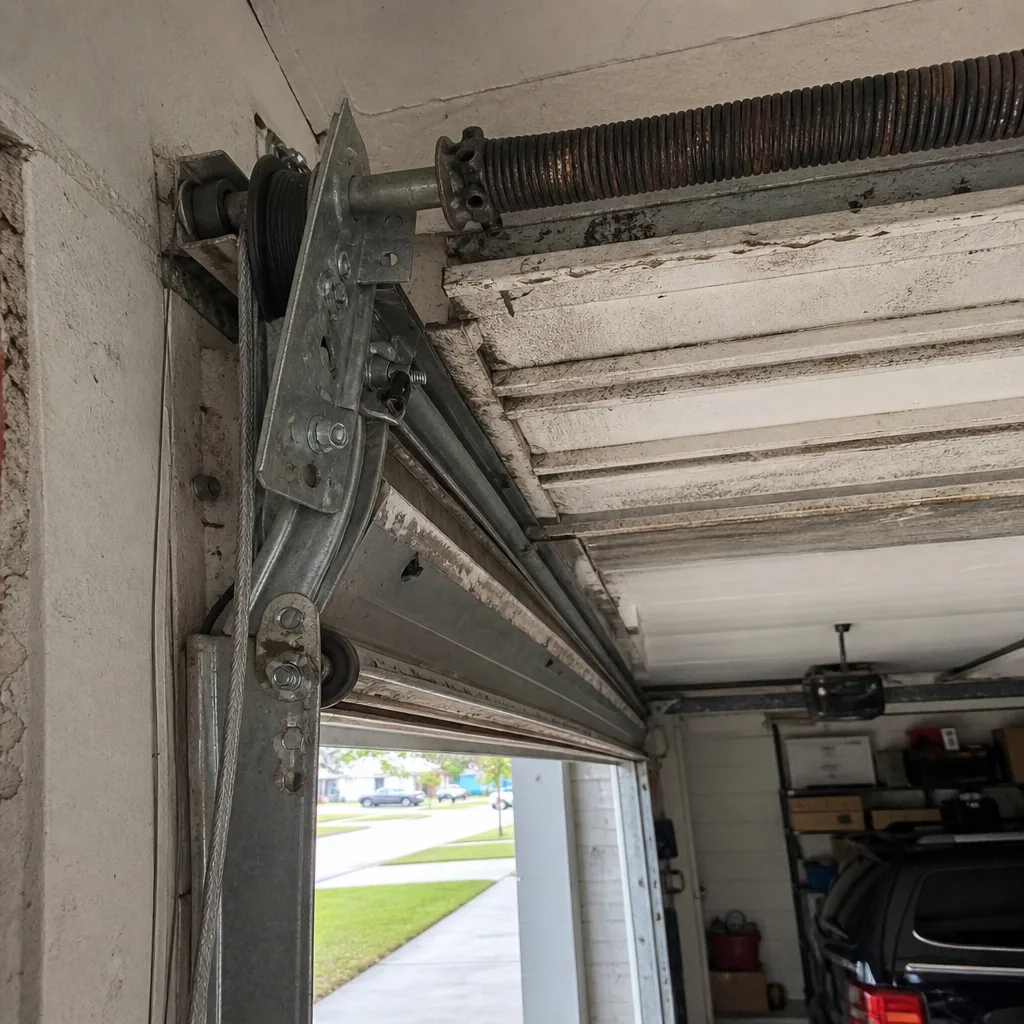 Before
 After
After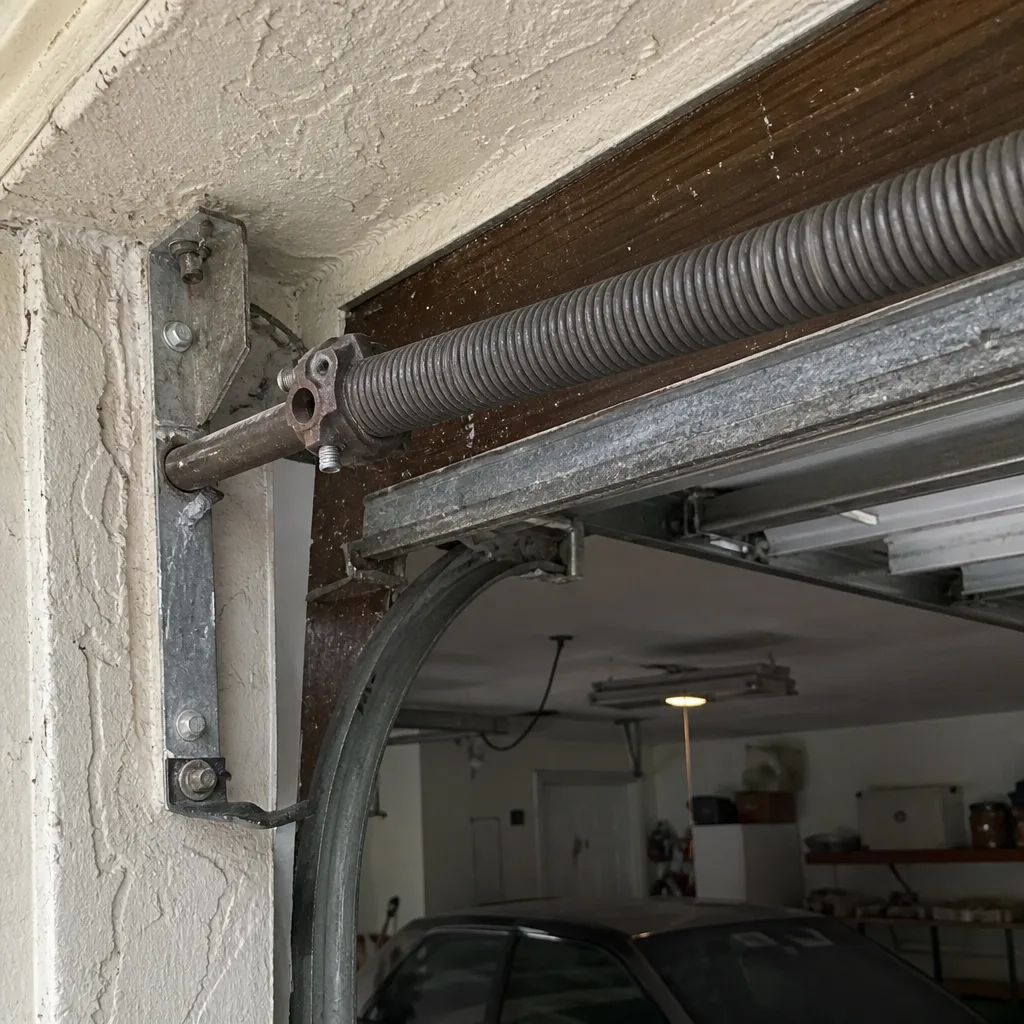 Before
 After
AfterDIY vs Professional Garage Door: The Coral Springs Homeowner’s Decision Guide
Most homeowners don’t get hurt doing garage door work because they lack mechanical ability. They get hurt because a torsion spring under load stores enough energy to break a wrist before you can let go of the winding bar. The question isn’t whether you’re handy. The question is which garage door tasks carry risk that skill cannot outrun, which require a licensed contractor under Florida Building Code, and which are genuinely fine to do on a Saturday morning. This guide draws those lines task by task, written for Coral Springs homeowners who’d rather know the actual trade-off than be told “leave it to the pros” without an explanation.
Quick Answer
For a Coral Springs homeowner, the DIY-versus-professional decision breaks down by task, not by general competence. Lubrication, sensor alignment, remote programming, and weatherstrip replacement are safe and reasonable DIY work; torsion spring replacement and cable work carry injury risk no amount of care eliminates; and full door replacement requires a permit under Florida Building Code, with owner-builder disclosure implications if you pull it yourself. Most homeowners should do the first category themselves, call a professional for the second, and think carefully about the third.
Table of Contents
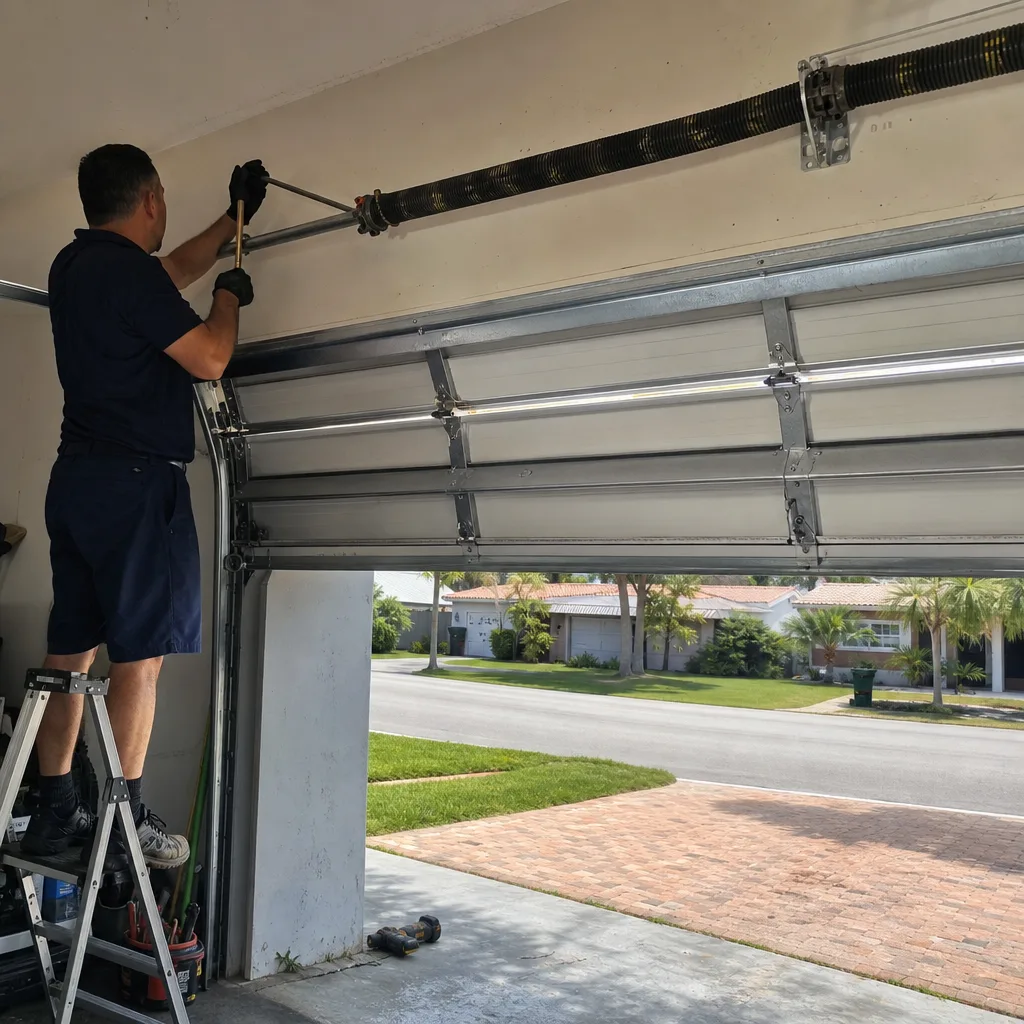
- Task-by-Task Risk Classification: What’s Actually Safe to Touch
- Torsion Spring Physics: Why Competence Is Not the Variable
- The Parts Problem: Why Ordering a Torsion Spring Online Goes Wrong
- Florida Building Code: The Permit and Owner-Builder Disclosure You Don’t Hear About
- The True Cost Comparison: DIY vs Professional, Accounting for Everything
- The Documentation Gap: What a Photo Record Gives You That a DIY Repair Can’t
- The Task Guide: What to Do Yourself and What to Hand Off
- Common Mistakes to Avoid
- When to Call a Professional
- Frequently Asked Questions
- The Bottom Line
BeforeAfterTask-by-Task Risk Classification: What’s Actually Safe to Touch
Garage door work splits into three categories, and the line between them is determined by stored energy and code requirements, not by how comfortable you are with a socket wrench. Here’s how we classify each category in Coral Springs, where humidity and salt air from the Atlantic add corrosion variables that change how parts fail.
Category 1: Homeowner-Appropriate Tasks
These are the jobs where a mistake costs you time or a $20 part, not a trip to the emergency room. They require no specialist tools and no permit.
- Lubrication of rollers, hinges, and tracks: Use a lithium-based or silicone spray on the metal-to-metal contact points. In Coral Springs, do this twice a year, because the humid season from June through October accelerates rust on exposed hardware.
- Sensor alignment: If your door reverses when closing or won’t close at all, the photo-eye sensors at the bottom of the track are often out of alignment or blocked. Cleaning the lens and adjusting the bracket is a 15-minute job.
- Remote and keypad programming: Every major brand, including LiftMaster, Chamberlain, and Genie, publishes step-by-step programming instructions for remotes and keypads. This is button-pushing, not mechanical work.
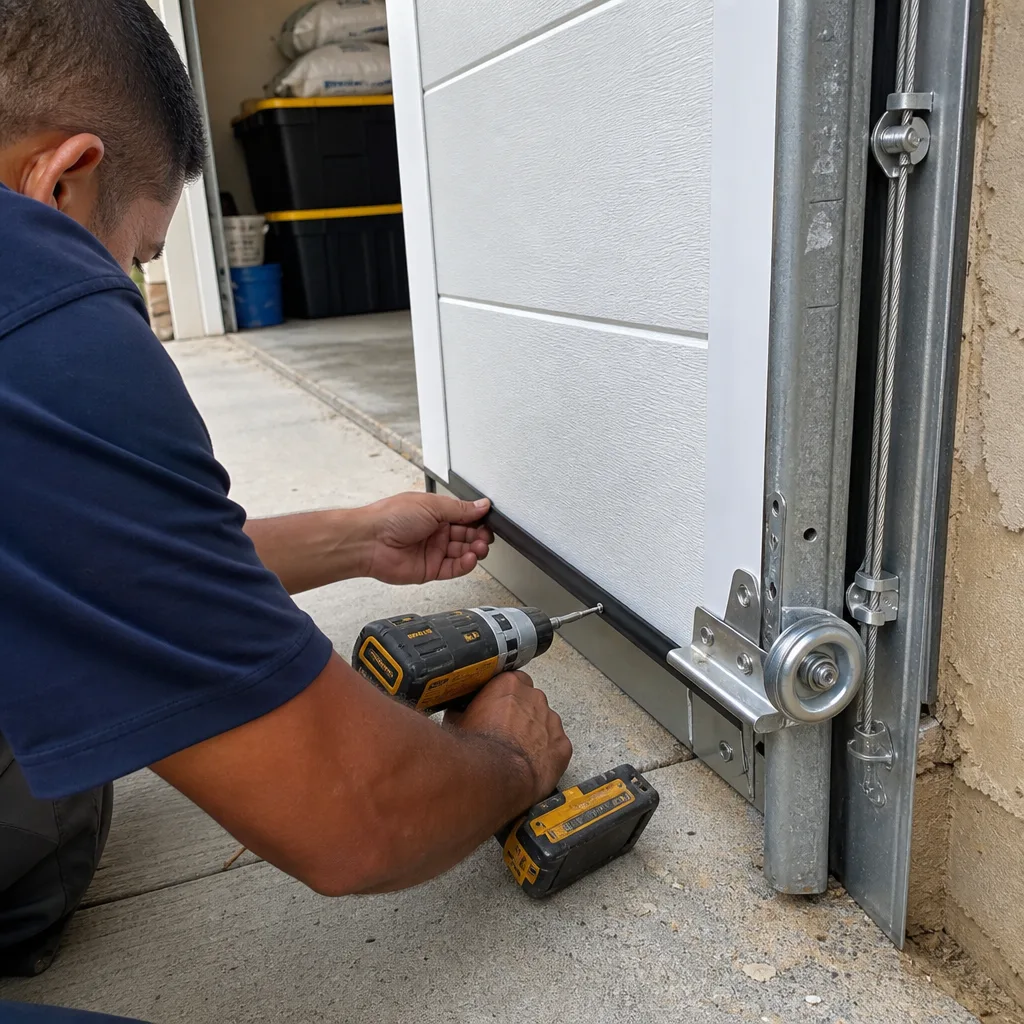
- Weatherstrip replacement: The rubber seal along the bottom of the door and the vinyl trim around the frame degrade in Florida sun. Replacing them is a low-risk, high-value job that keeps rain and bugs out.
Category 2: Injury-Risk Tasks Where Skill Is Not the Issue
These are the jobs that hurt people who know exactly what they’re doing. The risk comes from the component’s stored energy, not from the user’s technique.
- Torsion spring replacement: A fully wound residential torsion spring stores roughly 100 foot-pounds of torque. If a winding bar slips, that energy releases in a fraction of a second. We have seen the aftermath in Coral Springs garages from Weston to Parkland: broken hands, lacerated faces, and damaged drywall.
- Extension spring replacement: Older doors in some Coral Springs neighborhoods built in the 1980s and 1990s still use extension springs along the horizontal tracks. When one breaks under load, the spring and its safety cable can become projectiles.
- Cable replacement: The lift cables are under full door tension whenever the door is open. A frayed cable snapping during removal can whip across the garage.
- Track repair and adjustment: The vertical and horizontal tracks carry the door’s entire weight during travel. A loose track bracket under a 150-pound door can drop the door off its path.
Category 3: Licensed Work Under Florida Code
Full door replacement, and in some municipalities structural modifications to the opening, require a permit. We’ll get into the specifics of owner-builder rules shortly, but the short version is this: you can legally do your own work on your own home in Florida, but the permit you pull as an owner-builder follows the property. When you sell, you disclose that you did the work. That disclosure affects resale in a way most DIY guides never mention.
For repair work that stays within Category 2 or 3, our Garage Door Repair in Coral Springs page walks through what a professional repair actually includes, from the written price before work starts to the photo record after.
Torsion Spring Physics: Why Competence Is Not the Variable
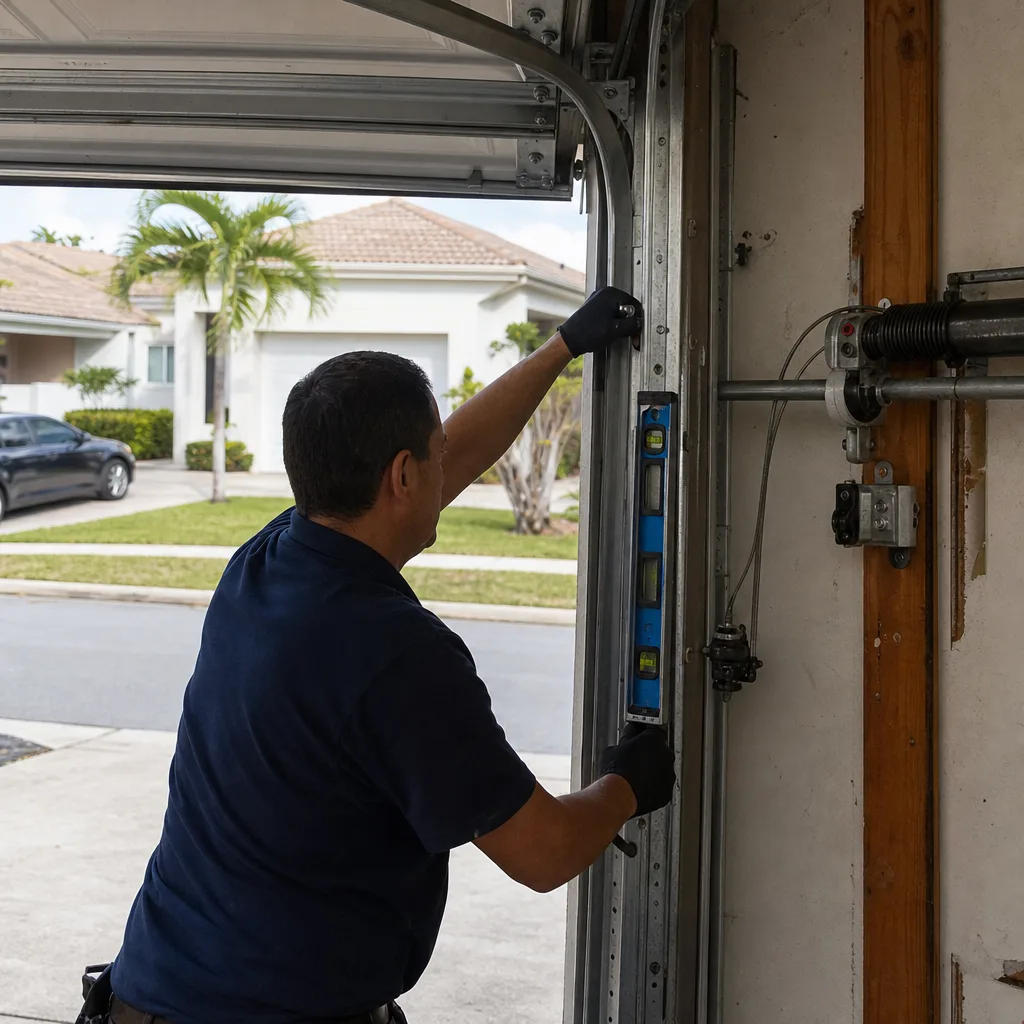
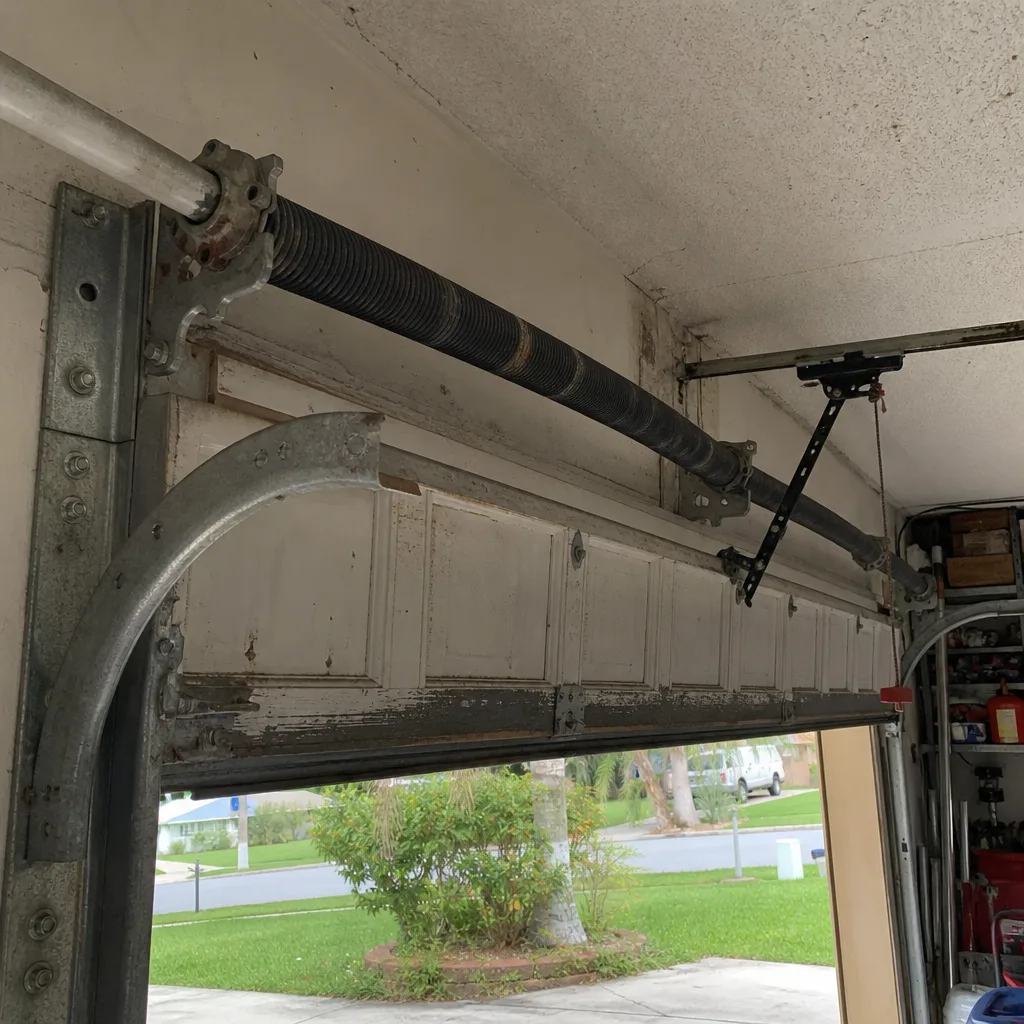
A torsion spring is not a coil spring you can buy at an auto parts store. It’s a precision-engineered component wound to a specific torque value that counterbalances the exact weight of your door. The spring above your garage door is under full tension every moment your door is closed. It holds that tension through thousands of open-and-close cycles over years, and when it breaks, it releases all of that stored energy at once.
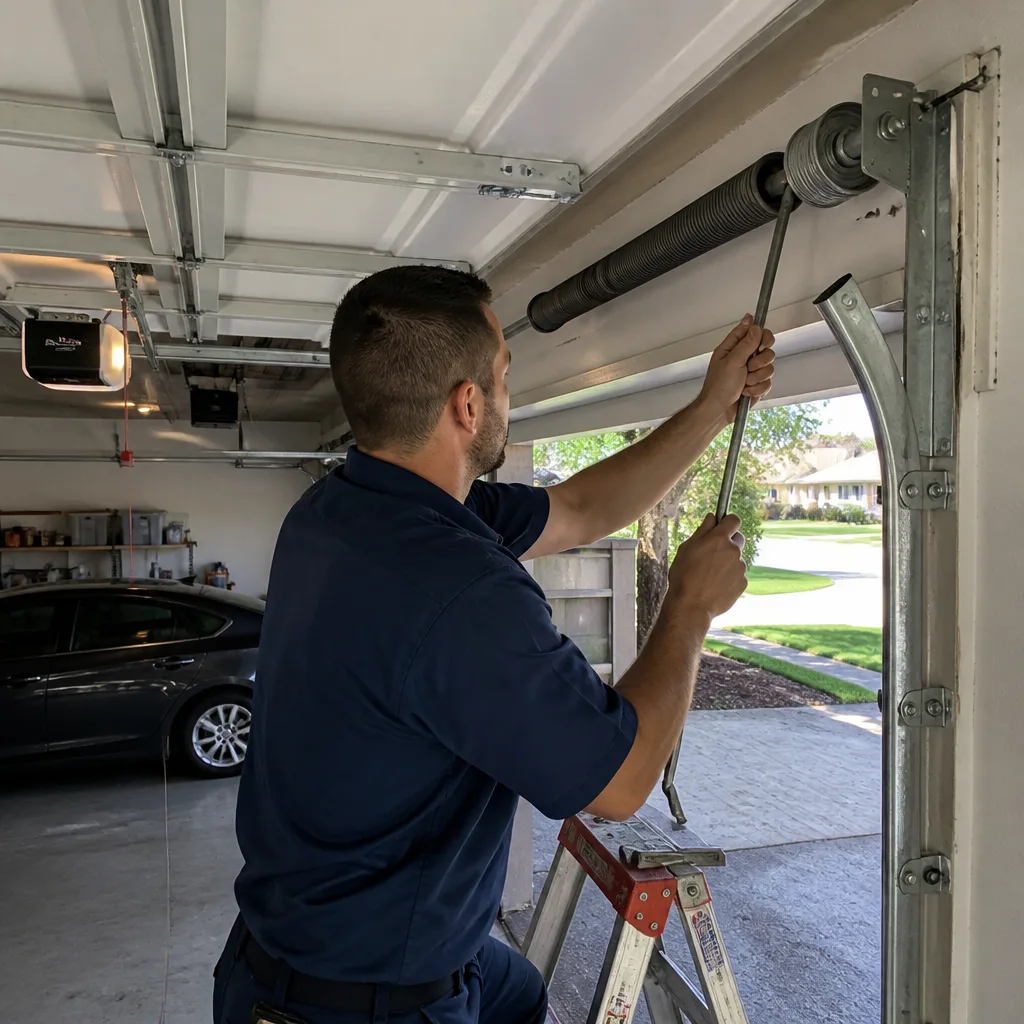
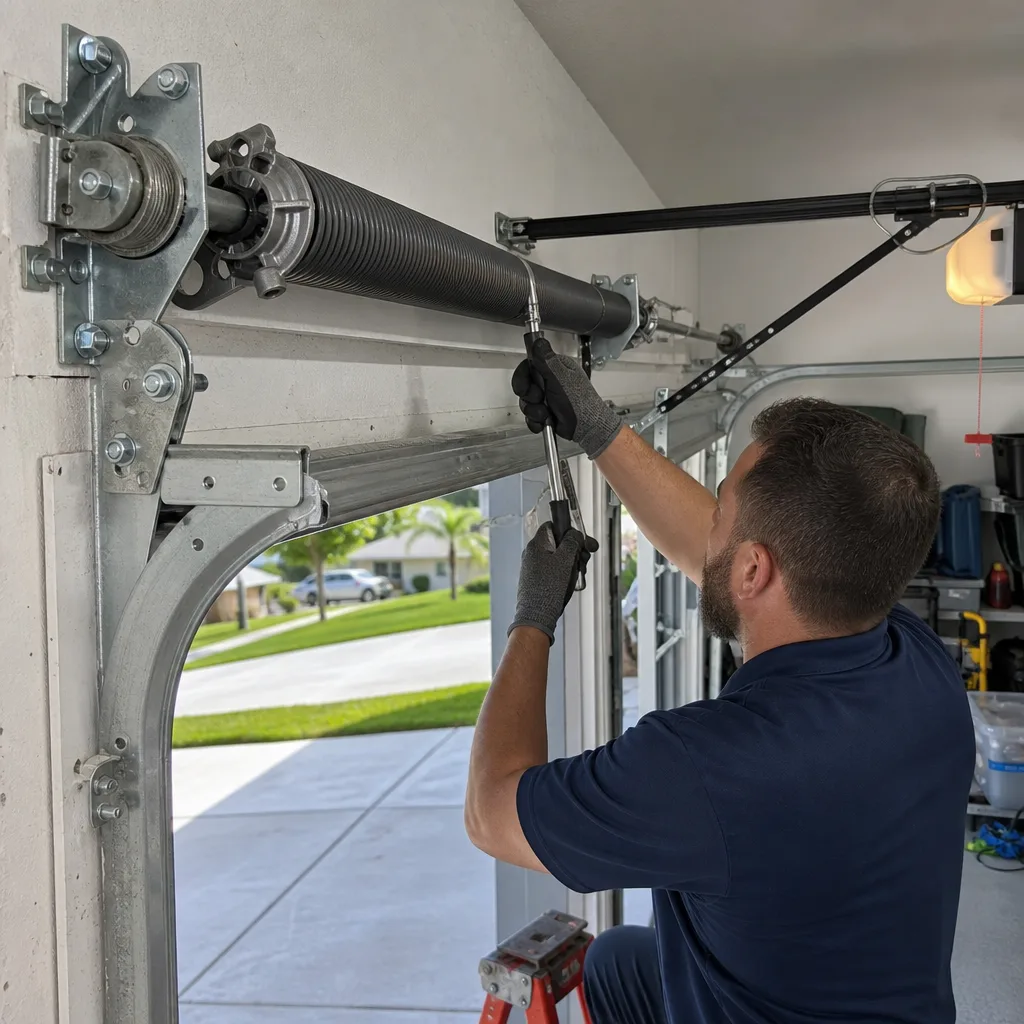
The numbers matter here. A standard 16-by-7-foot residential steel door in Coral Springs weighs between 150 and 180 pounds. The torsion spring assembly is wound to counterbalance that weight, which means the spring itself carries roughly the same load in torque. A homeowner standing on a ladder with two winding bars is managing that load manually while winding or unwinding the spring. If one winding bar slips out of the spring cone, the other bar becomes a lever that rotates with enough force to break bones or knock you off the ladder.
This is not a technique problem. Professional technicians who replace torsion springs every week still treat the job with the same procedure every time: secure the door, mark the spring position, use the correct-diameter winding bars, and never, ever stand directly in the path of the bars. The risk to a homeowner isn’t that you don’t know the steps. It’s that the step where the spring transfers its energy to your hands happens in a fraction of a second.
We see torsion spring failures across Coral Springs regularly, and in our experience the failure mode is often the same: a spring with a clean break at the coil, frequently caused by metal fatigue after years of humid, salt-adjacent air working on the spring’s surface. That’s a Coral Springs-specific detail worth knowing, because it means the spring that breaks wasn’t defective. It simply reached the end of its cycle life.
The Parts Problem: Why Ordering a Torsion Spring Online Goes Wrong
The most common DIY failure we see isn’t the repair itself. It’s the parts order that comes first. Torsion springs are sold in matched pairs, and they are specified by three measurements: wire diameter, inside diameter, and length. Get any one of those wrong and the door won’t balance.
Here’s where it goes wrong. A homeowner with a broken spring goes to a general retailer’s website, searches “garage door spring,” and finds a spring that looks right in the photo. The listing says “standard garage door spring” or “fits most doors.” What the listing doesn’t tell you is that a spring’s wire diameter is measured in quarter-inch increments, and a spring that’s even one wire size off will either under-balance or over-balance the door. An under-balanced door is heavy to lift and burns out openers. An over-balanced door slams open and creates a new set of hazards.
The matched-pair requirement is another trap. When one torsion spring breaks, the other spring on the same shaft is at the same age and cycle count. Installing only the broken one means the old spring fails weeks or months later, and you pay for the job twice. A professional replacement always replaces both springs as a set, but a DIY parts order often tries to save money by replacing only the broken side.
In Coral Springs, the parts access problem is compounded by the local climate. Springs need to be rated for the cycle life you actually use, and a standard spring from a generic supplier may be a 10,000-cycle spring when a 20,000-cycle spring is what a heavily used residential door in a two-car household really needs. The difference matters over five to seven years of daily use.
For a full picture of what a professional installation includes, our Garage Door Installation in Coral Springs page covers the brands we service, including Clopay and Amarr, and what the written scope looks like before any work begins.
Florida Building Code: The Permit and Owner-Builder Disclosure You Don’t Hear About
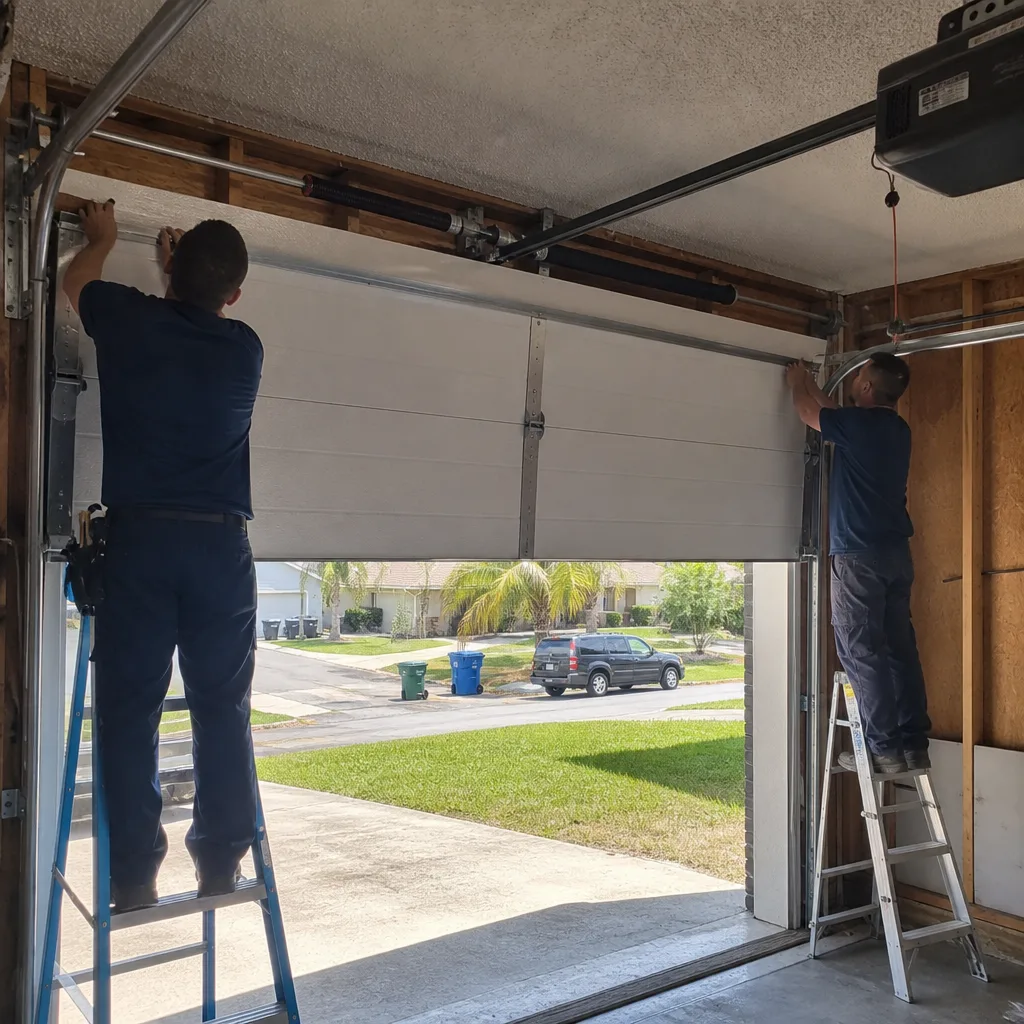
Florida law allows a homeowner to act as their own contractor on their own primary residence. That’s true and it’s well known. What’s less well known is the disclosure consequence that comes with it.
When you pull a permit as an owner-builder in Coral Springs, you sign an affidavit stating that you are performing the work yourself and that you understand you are responsible for it. That permit becomes part of the property’s public record. When you sell the home, Florida’s seller disclosure laws require you to disclose known defects and unpermitted work. If a buyer’s inspector finds that the garage door you installed as an owner-builder wasn’t done to code, that finding becomes a negotiation point against your sale price.
The alternative is hiring a licensed contractor who pulls the permit, does the work, and closes the permit with the city. The record shows a permitted, inspected installation completed by a licensed professional. For a garage door replacement, that’s a meaningful difference in a market like Coral Springs, where buyers in the 32-to-50 age range typically order thorough home inspections.
There’s another Florida-specific code point worth knowing. Hurricane-rated garage doors are required in Broward County for new construction and substantial remodeling. If you’re replacing a door on an existing home, you’re not automatically required to upgrade to a hurricane-rated door, but some insurance carriers offer premium reductions for homes with wind-rated garage doors. That’s a conversation to have with your insurance agent, and it’s one more variable in the DIY-versus-professional calculation.
The True Cost Comparison: DIY vs Professional, Accounting for Everything
The advertised DIY cost for a torsion spring replacement is the price of two springs from an online retailer: typically $80 to $120 for the pair. For a detailed look at what professional service actually includes, see our Garage Door Cost Breakdown: The Coral Springs Homeowner’s Reference for 2026. The advertised professional cost in Coral Springs is typically $280 to $380 for a two-spring replacement, including the springs, the labor, and the service visit. On paper, DIY saves about $200. In practice, the calculation is more complicated.
What the DIY Scenario Actually Costs
- Correct parts: $80 to $120 for a matched pair of springs with the correct wire diameter, inside diameter, and length. This assumes you measured correctly and ordered the right cycle rating. If you ordered wrong, you either pay return shipping and reorder, or you install a spring that doesn’t balance the door.
- Tools: Winding bars, a socket set, and a ladder are the minimum. If you own none of these, that’s $40 to $80. If you already own them, this line is zero, but most homeowners don’t own proper winding bars.
- Time: A professional replaces two torsion springs in 45 to 60 minutes. A first-time DIYer should budget four to six hours after watching tutorials, and that’s assuming nothing goes wrong. At even a modest hourly rate for your own time, that’s a real cost.
- Consequence cost: If the spring is installed with the wrong torque, the door opener’s lifespan drops. A replacement opener costs $300 to $500 installed in Coral Springs. If the door comes off its track during the work, you’re now looking at track repair on top of the spring replacement.
What the Professional Scenario Actually Includes
- Correct parts, sourced same day: A Coral Springs technician carries a range of spring sizes on the truck. The spring is matched to the door’s actual weight and cycle count, not to a guess from an online listing.
- The full inspection: A professional replacement includes checking the cables, drums, rollers, hinges, and opener force settings while the spring is being replaced. That inspection catches problems before they become emergencies.
- The written record: You get a flat, written price before work starts and a documented photo record when the technician leaves. That’s the documentation we’ll talk about in the next section, and it’s the part of the value proposition that doesn’t show up in a cost table.
| Cost Factor | DIY Torsion Spring Replacement | Professional Replacement in Coral Springs |
|---|---|---|
| Parts | $80-$120 (assuming correct order) | Included in flat price |
| Tools | $0-$80 | None |
| Time | 4-6 hours (first time) | 45-60 minutes |
| Emergency room risk | Non-zero | None |
| Documentation for insurance or resale | None | Written price, written scope, photo record |
| Total typical out-of-pocket | $80-$200 | $280-$380 |
The honest comparison isn’t $200 saved. It’s $200 saved against a multi-hour time commitment, a meaningful injury risk, and no documentation of what was done. For some Coral Springs homeowners, that trade is worth it. For most, once the full picture is on the table, it isn’t.
The Documentation Gap: What a Photo Record Gives You That a DIY Repair Can’t
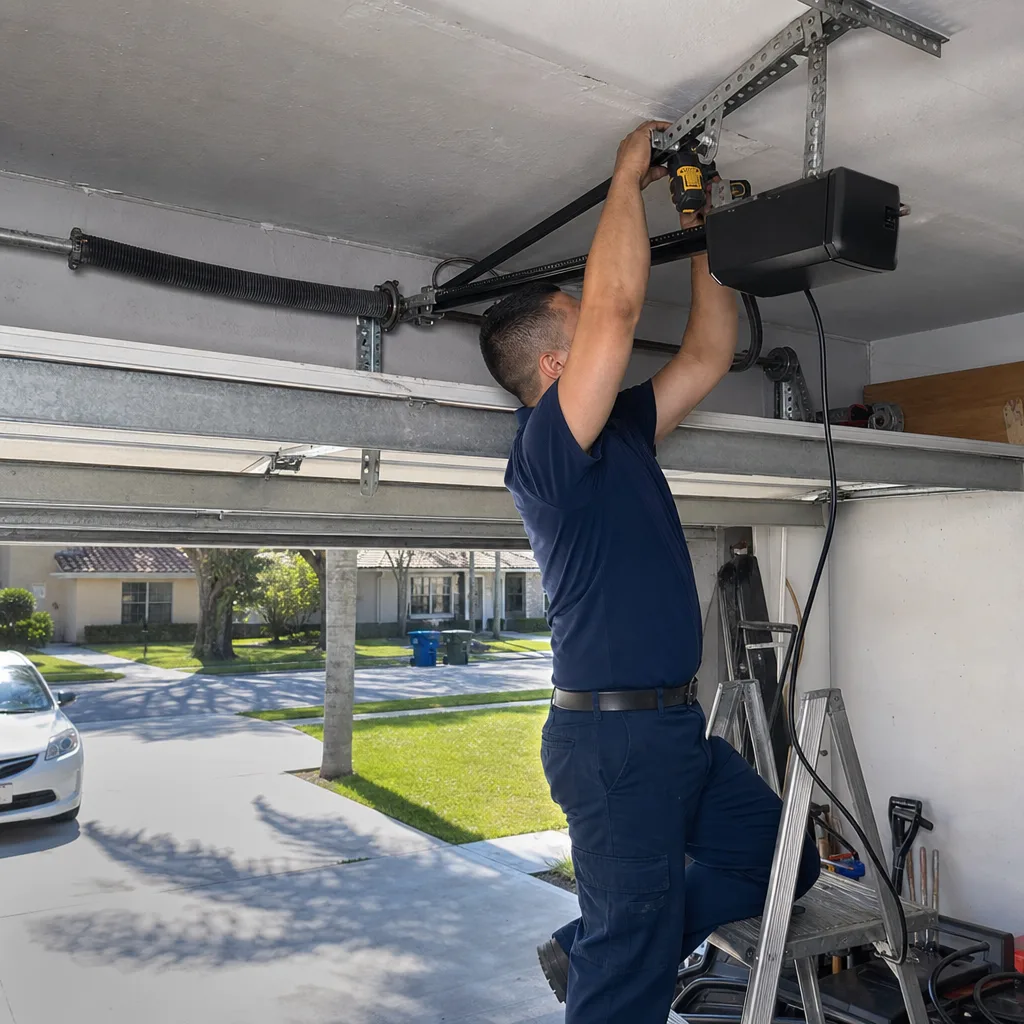
Here’s the difference that doesn’t make it into most DIY-versus-professional guides: a professional repair produces a paper trail, and a DIY repair produces nothing.
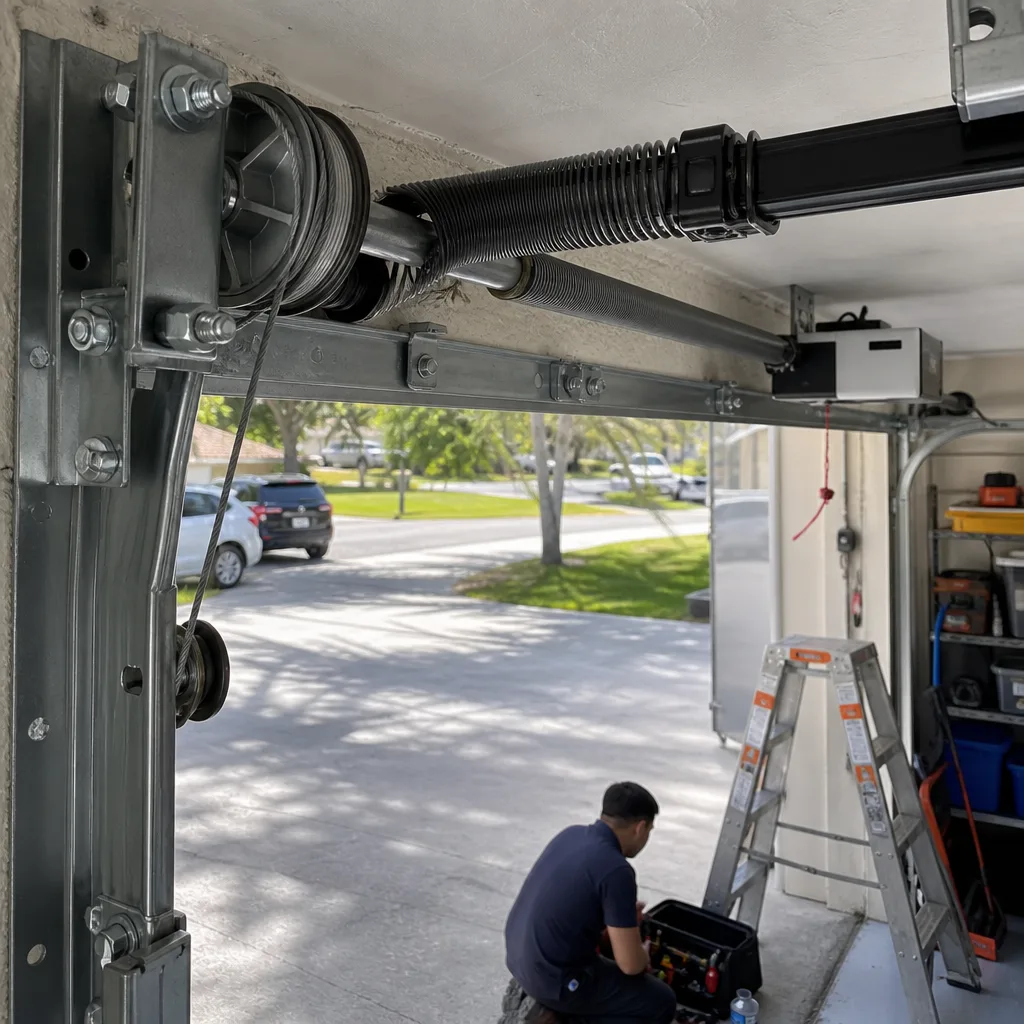
When a technician replaces a torsion spring on a Coral Springs home, the visit starts with a flat, written price and a written scope of work. The price the homeowner approves is the price on the invoice, because the price was quoted before work started, not after. Then, during the repair, the technician photographs the failed component before removing it. The homeowner sees the actual broken spring, the actual frayed cable, the actual worn roller, not a verbal description of it. When the job is done, the homeowner receives a documented photo record showing what was found and what was replaced.
That record matters in two situations. First, insurance. If a storm damages a garage door in Coral Springs, the claim process moves faster and more successfully when there’s a photographic record of the door’s condition before the damage and a documented history of prior repairs. Second, resale. The same buyer who wants to see permits on a renovated bathroom also wants to know that the garage door was maintained by a professional with a traceable record.
A DIY repair, no matter how carefully executed, produces none of this. There’s no photo of the failed component. There’s no written scope. There’s no record to show a future buyer or an insurance adjuster. The work itself might be fine, but the evidence that the work was done correctly doesn’t exist.
The Task Guide: What to Do Yourself and What to Hand Off
Here’s the complete breakdown, in plain terms, for a Coral Springs homeowner standing in the garage on a Saturday morning wondering whether to reach for the toolbox or the phone.
Do These Yourself With Confidence
- Lubricate the rollers, hinges, and springs: Twice a year, especially before the rainy season. Use lithium or silicone spray. Don’t use WD-40, which displaces the heavier lubricant.
- Realign the photo-eye sensors: If the door reverses for no reason, check the small LED lights on each sensor. If one is blinking, clean the lens and adjust the bracket until both lights are steady.
- Program a new remote or keypad: Find the model number on the opener unit, then follow the brand’s published instructions. LiftMaster, Chamberlain, and Genie all publish clear step-by-step guides.
- Replace the bottom weatherstrip: This is a slide-in rubber seal on most doors. The Florida sun degrades it in about two to three years.
- Tighten visible bolts and brackets: Use a socket set to snug any loose hardware you can see on the door and track. Don’t touch the track adjustment bolts themselves.
Call a Professional for These, Without Exception
- Torsion spring replacement: The physics don’t care how careful you are. Call a professional.
- Lift cable replacement: The cable is under load. Our Garage Door Opener Repair & Installation in Coral Springs page covers what this repair involves across the major brands, including LiftMaster and Chamberlain openers.
- Track repair or realignment: If the door is off its path or makes grinding noises, the issue is often the track. This is a weight-bearing component.
- Full door replacement: Pulling a permit as an owner-builder has resale consequences. A licensed contractor handles the permit and closes it properly.
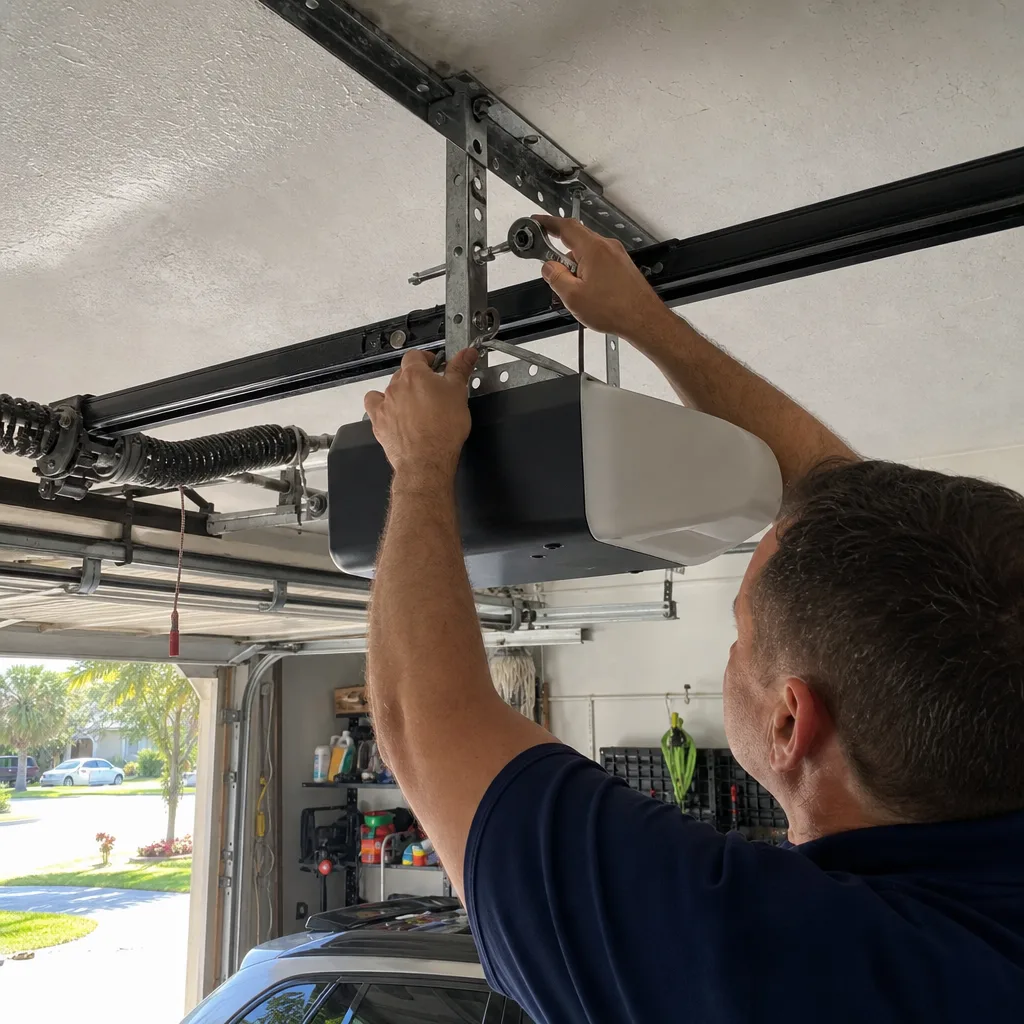
- Opener logic board or motor replacement: The electrical work here is low voltage, but the diagnostic step is where DIY goes wrong. You can replace a part that wasn’t actually the problem and spend more than a professional would have charged for the correct diagnosis.
For the full service picture, the Servo Garage Doors Coral Springs home page lists what we cover: repair, installation, opener work, parts, and 24/7 emergency service, all under the same written-price-first system.
Common Mistakes to Avoid
- Using the wrong lubricant on the springs and rollers. WD-40 is a solvent, not a lubricant. It strips the existing lubrication. Use a lithium-based or silicone spray.
- Replacing only one torsion spring. Springs are changed in matched pairs. Replacing only the broken one means the other, which is the same age and has the same wear, fails soon after, and you pay for labor twice.
- Disconnecting the opener to open the door manually when the spring is broken. Without the spring’s counterbalance, the door is dead weight. If it slips, it drops fast enough to injure someone.
- Using screwdrivers or rebar as winding bars. The winding bar has to be the exact diameter of the winding cone hole. A slightly undersized bar slips, and a slipped bar is the source of most torsion spring injuries.
- Adjusting the opener’s force settings without a reason. The force setting is a safety feature. Cranking it up to make a poorly balanced door close properly masks the real problem, which is the spring or the cable, and creates a door that could close on a person or a car.
- Pulling an owner-builder permit without understanding the disclosure requirement. When you sell the home, you disclose that you did the work. A buyer with a thorough inspector will ask the question.
- In Coral Springs specifically: ignoring rust on the torsion springs. In the humid months, surface rust develops quickly. Rust pits the spring’s surface, and pitted springs break early. If you see rust blooms on the spring coils, it’s a sign the spring is approaching the end of its life.
When to Call a Professional
Call a professional when the broken part is under load: a torsion spring with a visible break, a frayed lift cable, a door hanging unevenly on its tracks. Call a professional when the door won’t open and you can’t identify the cause without guessing. Call a professional when the job requires a permit, because the permit’s disclosure consequences outlast the repair. And call a professional when you want a written record of what was found and what was done, not just a fixed door. For a complete guide to keeping your door in top shape, see our Garage Door Repair Maintenance Checklist for Coral Springs Homeowners. Servo Garage Doors Coral Springs offers free estimates in Coral Springs, with a flat written price and written scope before any work begins. Call (754) 399-3666 and you’ll speak to a person, not a recording, 24 hours a day including holidays.
Frequently Asked Questions
Yes, Florida law allows a homeowner to perform work on their own primary residence, including garage door work. However, pulling a permit as an owner-builder creates a disclosure obligation when you sell the home, and any repair involving a torsion spring or lift cable carries injury risk that legality doesn’t address.
A two-spring torsion spring replacement in Coral Springs typically costs $280 to $380, including the springs, labor, and the service visit. The price is quoted and agreed before any work starts, and the spring is matched to the door’s weight and cycle count. Call (754) 399-3666 for an exact quote, with no obligation.
No. Torsion springs are designed and sold as matched pairs, and both springs on a door wear at the same rate. Replacing only the broken spring leaves an old spring that will fail soon, and you will pay for labor twice.
Torsion spring replacement is the most dangerous, because the spring stores roughly 100 foot-pounds of torque when wound and releases it instantly if a winding bar slips. The danger exists regardless of the person’s skill level or carefulness.
Yes, full garage door replacement typically requires a permit under Florida Building Code, and a homeowner acting as an owner-builder must sign a disclosure affidavit. A licensed contractor handles the permit and closeout as part of the job.
Lubrication, sensor realignment, remote and keypad programming, and weatherstrip replacement are all safe DIY tasks. None of them involve components under load, and none require a permit. Our Garage Door Repair in Coral Springs page covers the full range of professional repairs for the tasks beyond this list.
The Bottom Line
The DIY-versus-professional question for garage doors in Coral Springs is not about your skill level. It’s about which tasks carry risk that no amount of competence removes, which require permits under Florida Building Code, and which documentation you want to have when the work is done. Lubricate, clean, program, and replace weatherstripping yourself. Leave torsion springs, cables, tracks, and full replacements to a professional who photographs the failed component before quoting a replacement and gives you a written record when the job is complete. That’s not an upsell. It’s what a good decision looks like when the full picture is on the table. For more guides & resources, visit our blog.
Written by Marcus Deller, Owner at Servo Garage Doors Coral Springs, serving Coral Springs since 2015.