
Last updated September 20, 2026
Full 25-point door and opener safety check with every visit - springs, cables, rollers, tracks, and your LiftMaster or Chamberlain opener included
You get a price before we start. It does not change when the truck arrives.
 Before
 After
After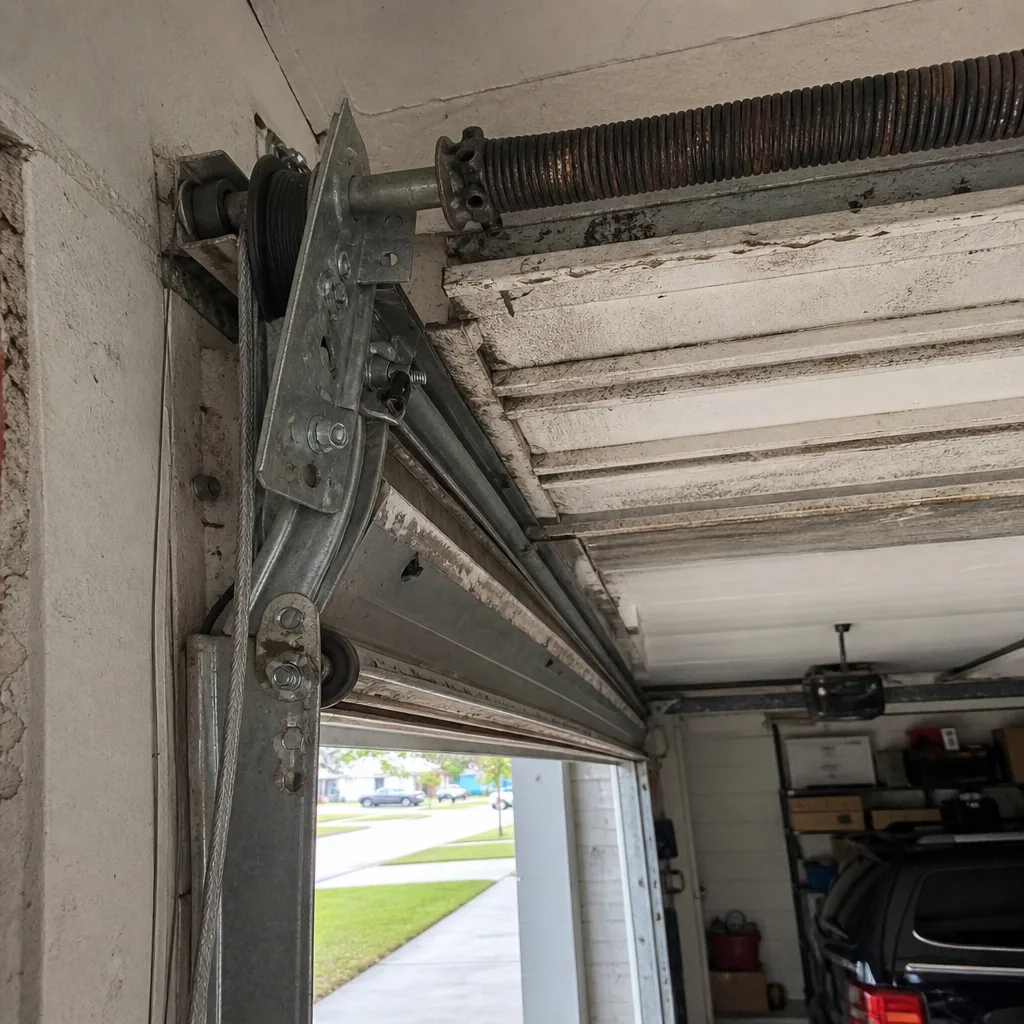 Before
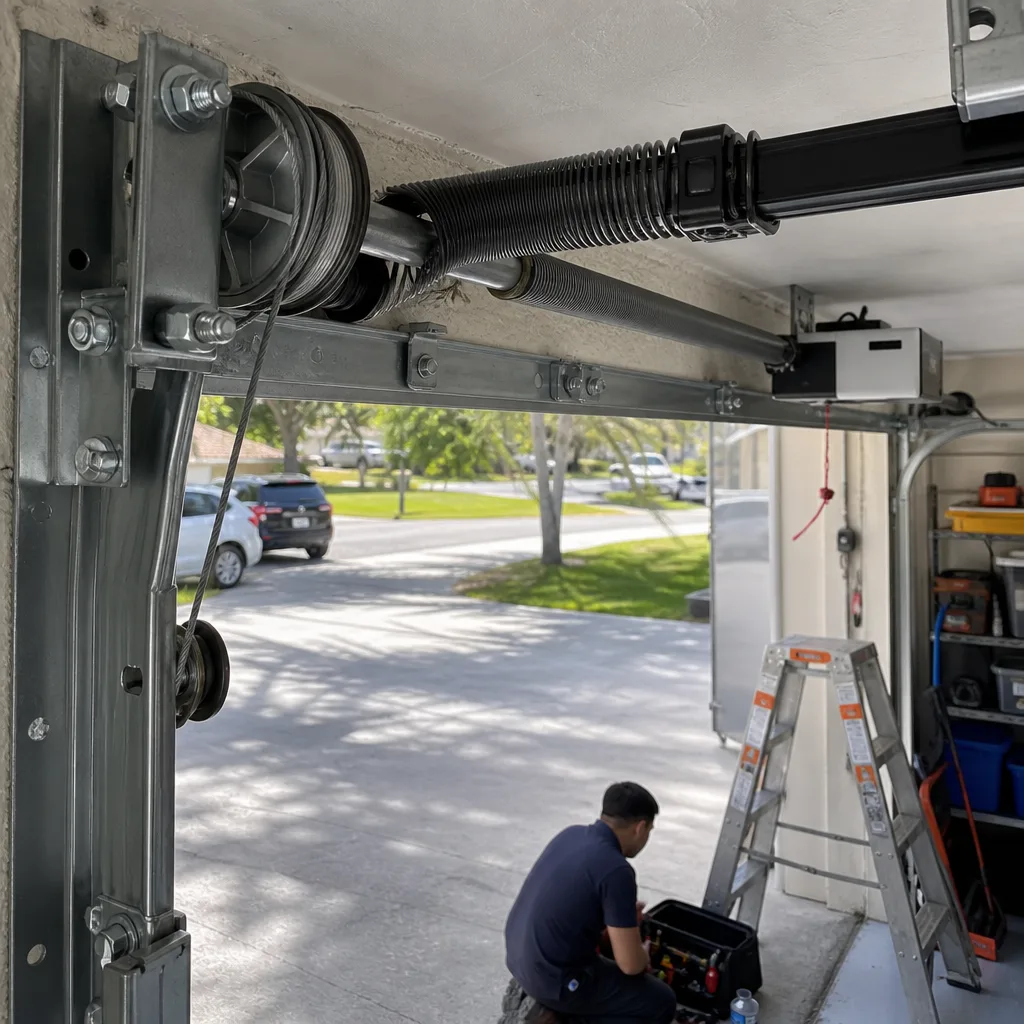 After
After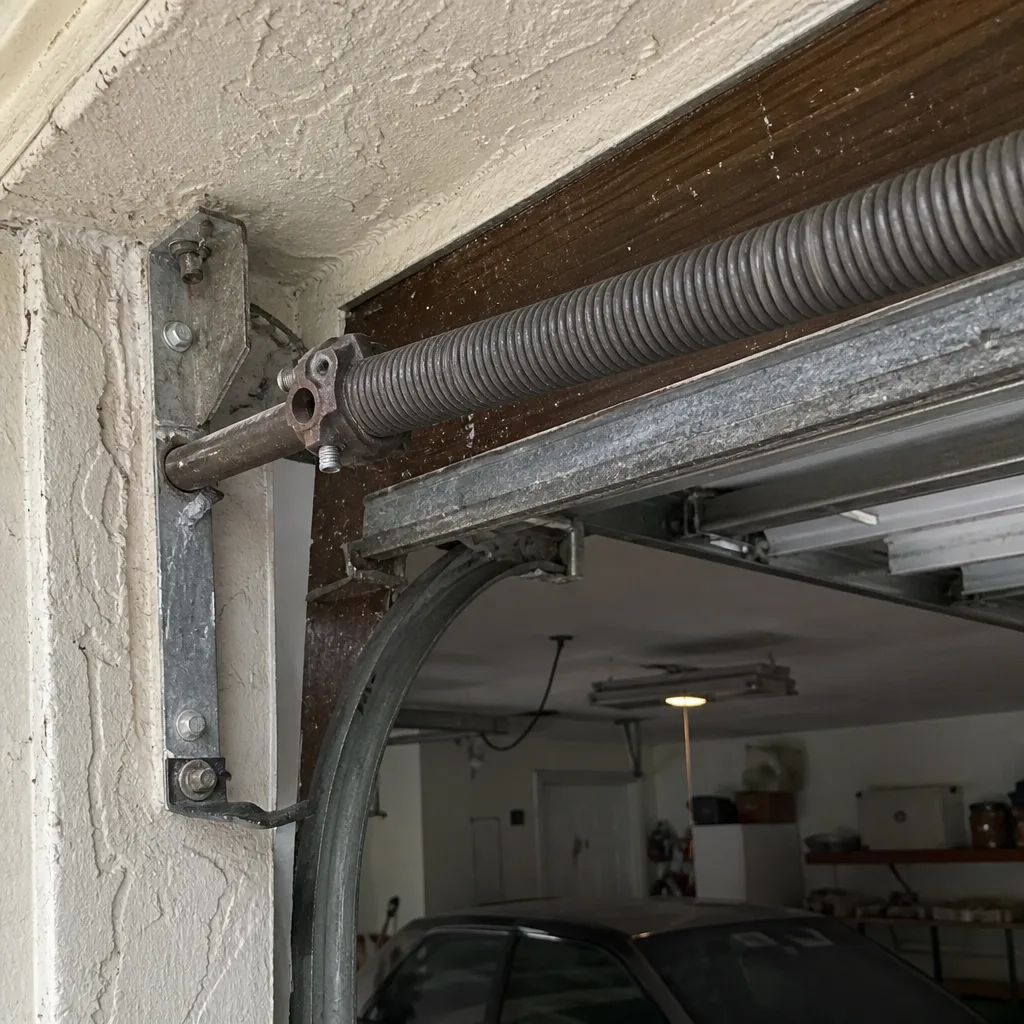 Before
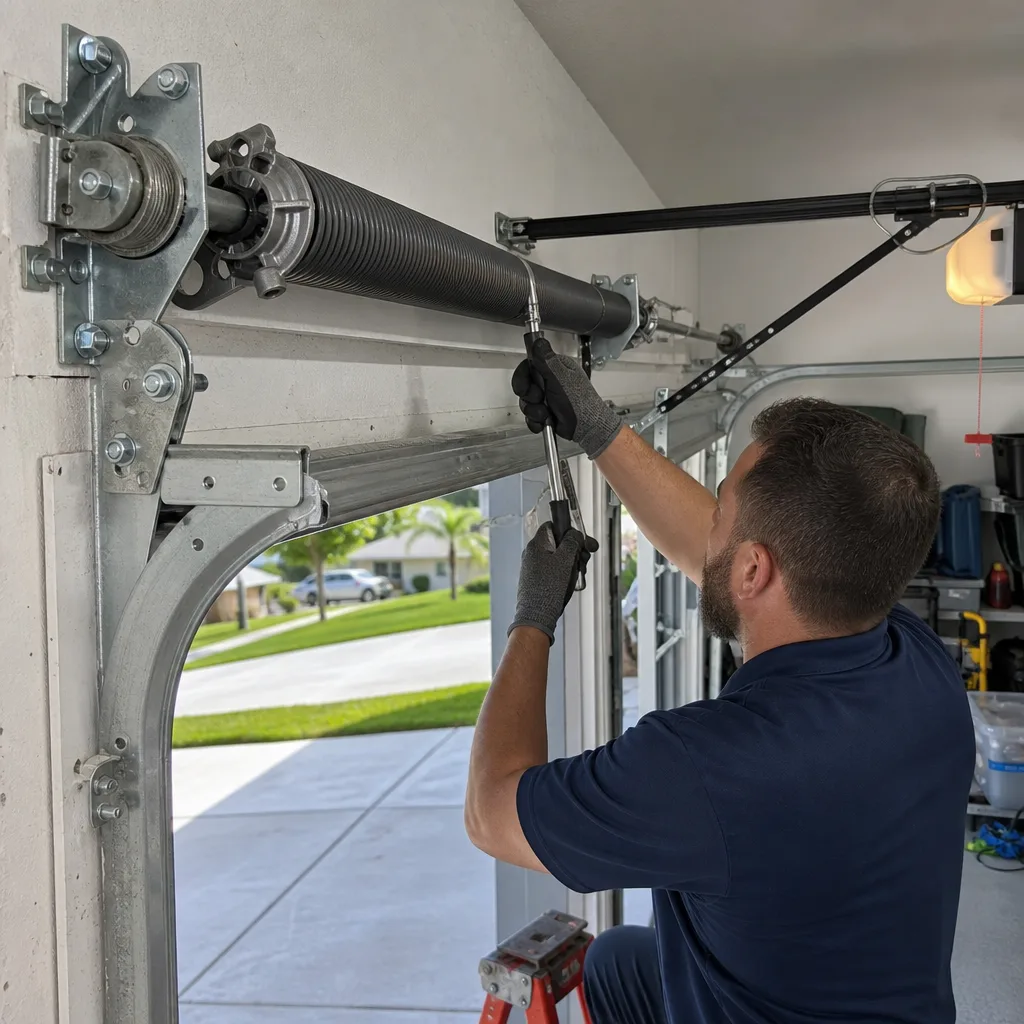 After
AfterGarage Door Warning Signs: A Coral Springs Homeowner’s Reference Guide
Here’s the counterintuitive part: a garage door that reverses unexpectedly is often the one working correctly. The opener’s force limiter is doing its job. The real problem is the door itself, heavier on one side, dragging against a track, fighting a spring that lost tension months ago. In Coral Springs, where summer humidity swells wood and composite panels and salt air works on hardware year-round, the warning signs show up earlier than they do inland. This guide maps each observable sign to the specific component failing, what it costs to fix if you catch it now, and what it costs if you don’t. For a broader overview of maintenance and installation, see our Complete Guide to Garage Door in Coral Springs.
Quick Answer
Garage door warning signs fall into four categories: noise (grinding, popping, squealing), visual damage (rust, frayed cables, bowed panels), movement problems (reversing, slowness, imbalance), and opener behavior (clicking, partial operation, inconsistent travel). Most indicate a specific failing component: torsion springs, cables, rollers, track alignment, or the opener’s logic board. A door that’s noisy but moves smoothly is typically a maintenance issue under $200. A door that’s unbalanced or bangs through travel is a spring or cable problem, and in Coral Springs that repair generally runs $180 to $340 for a single spring, $300 to $550 for a pair.
Table of Contents
- Noise Signs: Grinding, Popping, Squealing, and What Each Means
- Visual Signs: Rust, Fraying, and Coral Springs-Specific Corrosion
- Behavioral Signs: Reversal, Slow Travel, and the Balance Test
- Slow Door vs. Unbalanced Door: Two Different Problems
- Opener Warning Signs: Clicking, Partial Operation, and Logic Board Failure
- How Coral Springs Climate Accelerates Garage Door Wear
- Documentation Before You Call: Why Photos Change the Quote
- Common Mistakes to Avoid
- When to Call a Professional
- Frequently Asked Questions
- The Bottom Line
BeforeAfterNoise Signs: Grinding, Popping, Squealing, and What Each Means
Noise is the earliest warning sign a garage door gives, and it’s also the most misread. A door that groans when it moves isn’t “just old.” The sound has a source, and that source is a specific component telling you something about its condition. Here’s the mapping we use on service calls across Coral Springs neighborhoods like Cypress Glen and The Isles:
Grinding with no rhythmic pattern
Grinding that sounds like metal dragging across metal almost always means the rollers are worn or the track is misaligned. Steel rollers with worn bearings stop spinning and start scraping, which shaves metal off the track over time. The fix is roller replacement, typically $120 to $180 for a full set of nylon rollers on a single door. If the track itself is scored, that’s a track replacement, closer to $200 to $350. Left alone, a grinding roller carves deeper into the track until the door jams mid-travel.
Popping at a specific point in travel
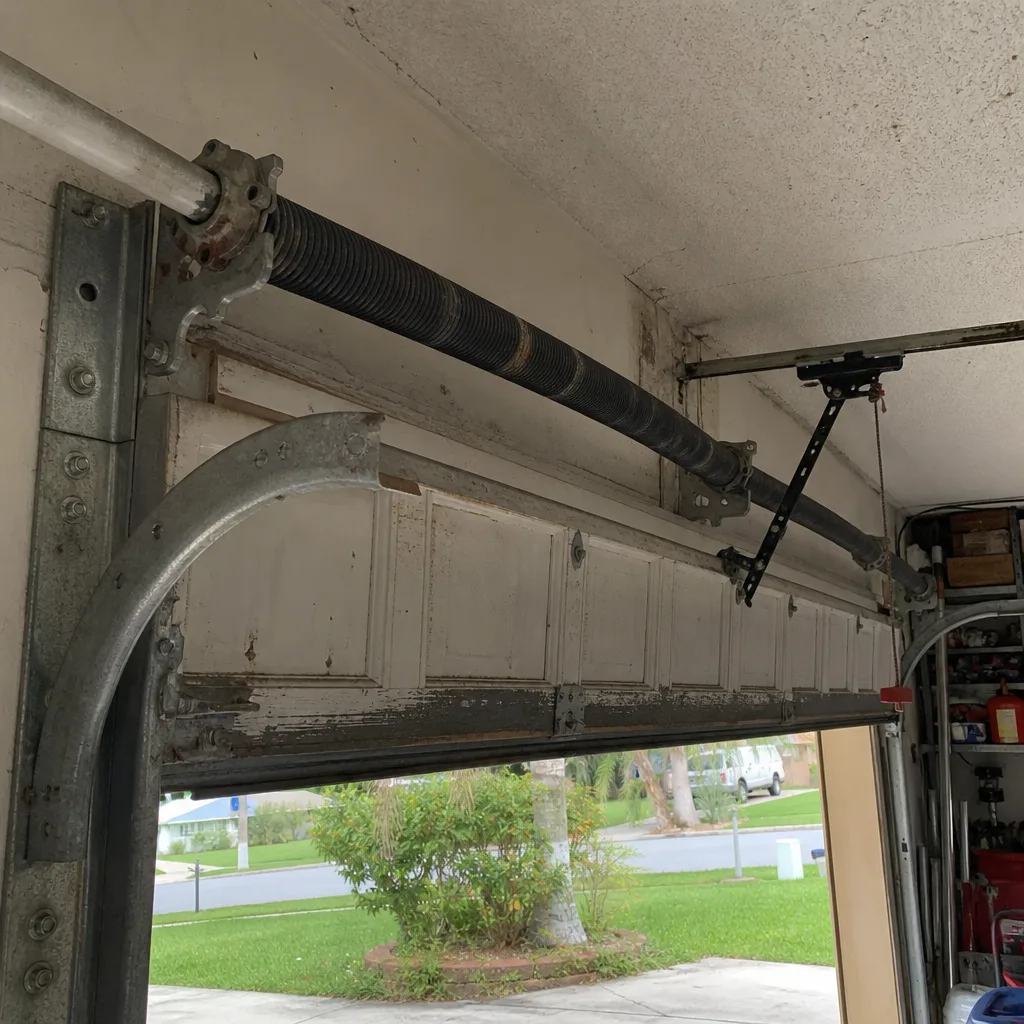
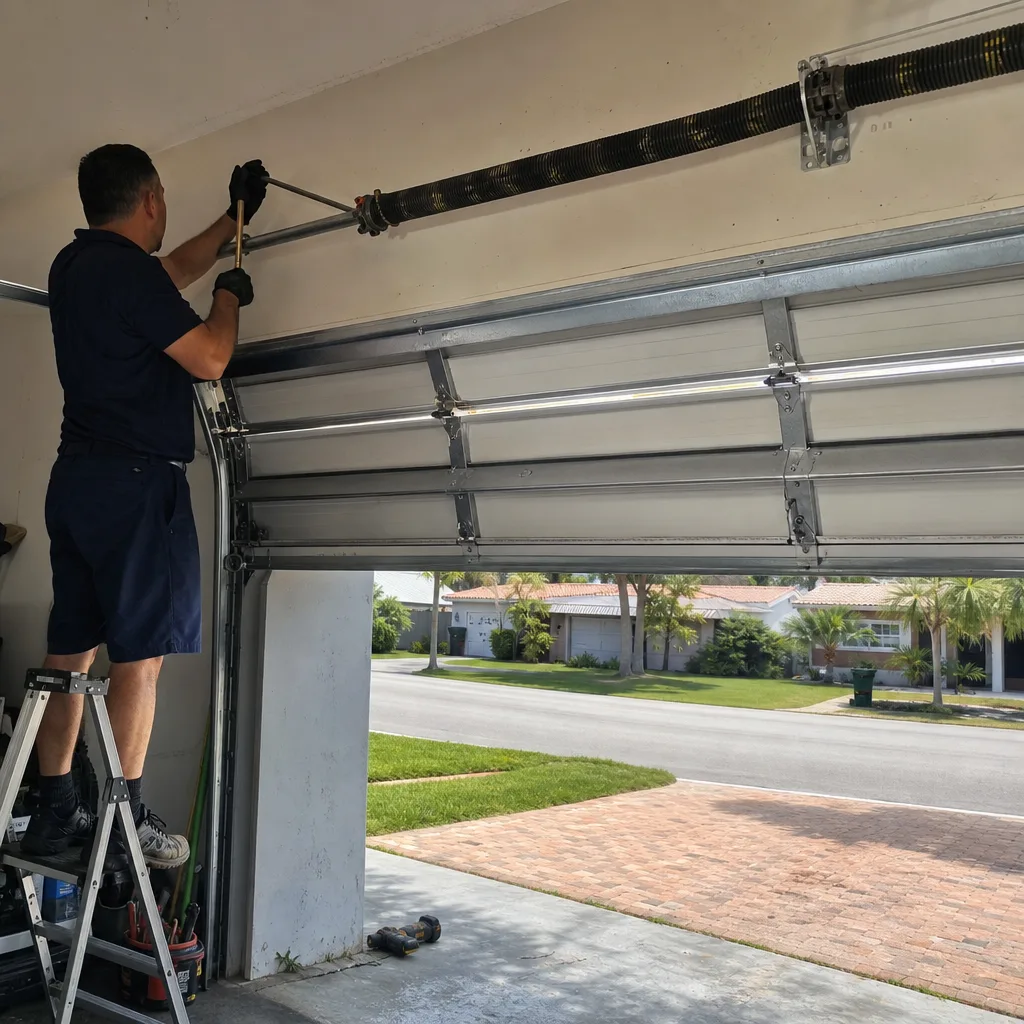
A sharp pop, especially when the door passes a certain point, is usually a torsion spring coil catching and releasing. The spring is beginning to bind, and the pop is the sound of a coil slipping over a break that hasn’t fully separated yet. This is a pre-failure indicator, not a nuisance noise. A popping torsion spring is measured in days or weeks before it breaks clean through, and when it does, the door will not open manually or with the opener. Spring replacement in Coral Springs runs $180 to $340 for a single spring, $300 to $550 for a pair, and it’s not a repair you want to be scheduling at 6 a.m. on a workday.
Squealing or high-pitched whine
Squealing is friction at the hinge points, usually resolved with lubrication. But here’s the distinction: a squeal that changes pitch with travel speed is a hinge issue. A squeal that stays constant regardless of door position is the opener’s drive gear inside the unit. The first is a $15 can of garage door lubricant. The second is an opener repair or replacement. If you lubricate the hinges and the squeal persists, you’ve isolated the problem to the opener, and that’s useful information when you call for service.
Rhythmic clicking during operation
A steady click-click-click as the door moves is almost always a roller bearing that’s flat-spotted or a hinge pin that’s worked loose. Roller bearings should be silent. A rhythmic click means one roller is skipping instead of rolling, and every skip is a small impact against the track. This is a fix-now item, but it’s a minor one: most roller replacements are done in under an hour. Coral Springs homeowners who catch this early avoid the scraped track that turns a $150 repair into a $300 one.
Noise signs map directly to repair scope, and the mapping is predictable enough that we can usually estimate a job from a 20-second phone recording. But the one noise you should never ignore is popping from the spring area. That’s not a maintenance issue. That’s a structural component announcing it’s about to let go.
Related: Garage Door Repair in Coral Springs covers our full diagnostic process for noisy doors.
Visual Signs: Rust, Fraying, and Coral Springs-Specific Corrosion
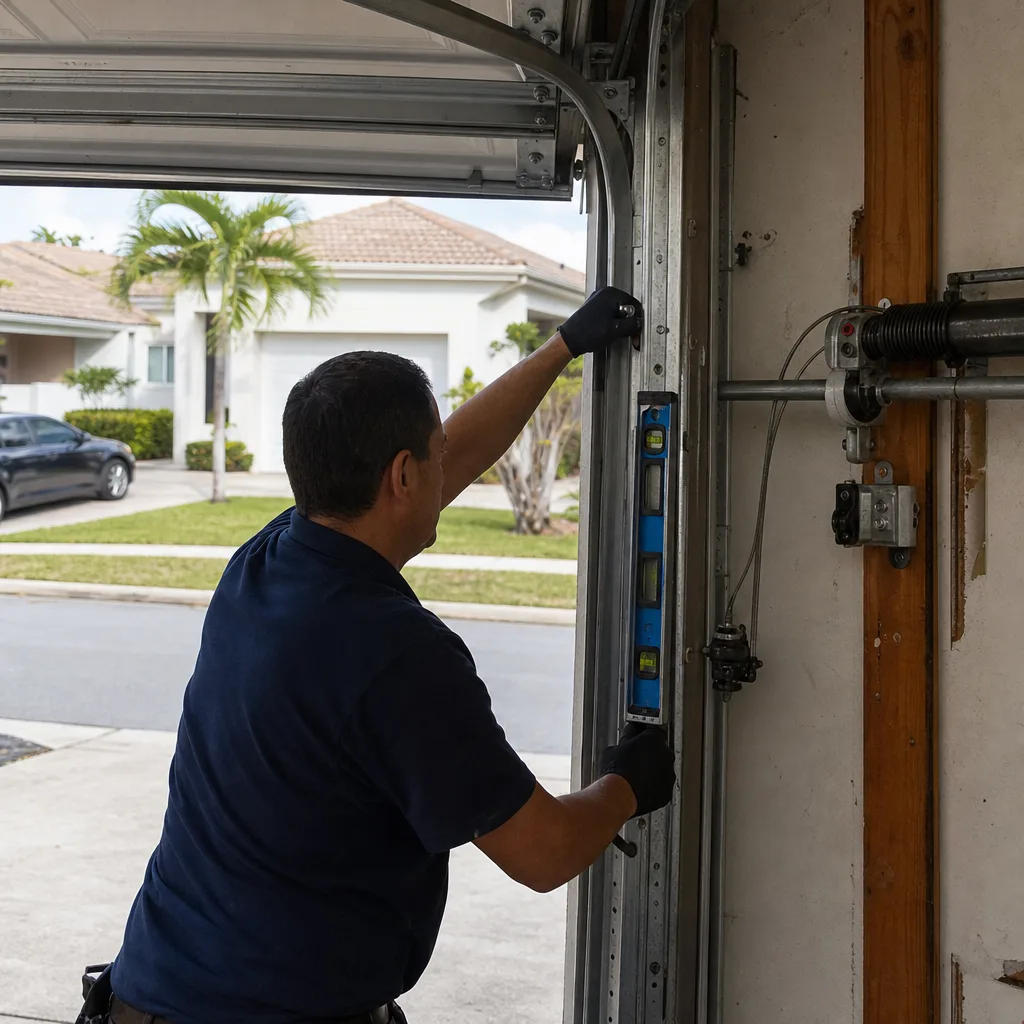
South Florida is hard on garage hardware in ways that northern climates never experience. The combination of salt air, high humidity, and frequent afternoon thunderstorms creates corrosion patterns that look different from ordinary rust. Knowing what you’re looking at helps you judge whether a visual sign is cosmetic or structural.
Cable rust: the migration pattern that matters
Garage door cables are galvanized steel, and they fail in a predictable sequence. The first sign is surface rust, which spreads along the cable in a speckled pattern. That’s not urgent. The second sign is rust concentrated at the bottom bracket, where the cable attaches to the door, because that’s the point that sits closest to ground moisture and collects condensation. When you see dark rust at the bottom bracket, the cable’s load-bearing capacity is compromised even if the rest of the cable looks clean. A cable that snaps under tension is dangerous: it releases the stored spring energy unpredictably and can lash out. If you see rust at the bracket, stop using the door and make the call.
White oxidation on aluminum tracks
Aluminum doesn’t rust, but it oxidizes, and in Coral Springs that oxidation shows up as a chalky white film along the track. It’s not structural by itself, but it increases friction, which makes the opener work harder, which shortens opener life. More importantly, heavy oxidation is a signal that the track has been wet repeatedly, which means the track fasteners may also be corroding. We’ve pulled tracks off homes in Parkland and Heron Bay where the track looked fine from a distance but the bolts crumbled when we touched them.
Bottom bracket corrosion: minor-looking, structurally serious
The bottom bracket is a small gray corner piece that nobody notices until it fails. In Coral Springs garages, these brackets catch everything: driven rain, pooled water from a wet car, salty air circulating near the floor. Light surface rust is common and not urgent. But when you see flaking, layering, or rust that’s eaten material away, the bracket is close to failure. The bottom bracket carries the full torsion of the cable, which means the entire door’s lifting force is hung on that small piece of metal. Replacement is $80 to $150 for the bracket and cable assembly, and it’s preventive work that keeps the cost at that number instead of the $400 to $700 range for repairing damage after a bracket fails and the door drops one corner.
Panel bowing or warping on wood and composite doors
Coral Springs humidity does particular damage to wood and composite doors. Panels absorb moisture during the wet season, swell, and then dry unevenly when the air conditioning dries the garage. The result is a bow: a panel that’s no longer flat. A bowed panel is not just an appearance problem. It changes the door’s weight distribution and can cause the door to bind against the track. We see this most often on older Amarr and Clopay wood-composite installations in lakeside communities, where houses sit closer to constant moisture. Once a panel has bowed, it rarely straightens. The realistic fix is panel replacement, and that’s a conversation worth having before the door stops opening reliably.
Visual signs reward someone who looks. A homeowner who photographs the rust, the oxidation, the bracket wear before calling gives their technician a head start on diagnostics, and it prevents scope creep during the visit because the evidence is already on record.
Behavioral Signs: Reversal, Slow Travel, and the Balance Test
Behavioral signs are the most useful category because you can test for them in under five minutes with no tools. Here’s what to watch and what it means when you see it.
Unexpected reversal mid-travel
The standard assumption is that a reversing door has a misaligned sensor. Sometimes that’s true. But in Coral Springs, where doors sit in humid garages, sensor misalignment is only one of three common causes. A door that swelled during the wet season gets heavier, and the opener’s force limiter, which was set for the door’s original weight, now reads the heavier door as an obstruction and reverses it. That means the opener is doing its job correctly and the door is the problem. The third cause is a failing logic board, which misinterprets sensor signals. The diagnostic sequence is: check sensor alignment, disconnect and lift the door manually to feel its weight, then test the opener. If the manual lift feels heavy or uneven, the door is the culprit, not the sensors.
The manual balance test: the single most useful diagnostic you can do yourself
- Close the door completely.
- Pull the red emergency release cord hanging from the opener rail. This disconnects the door from the opener carriage.
- Lift the door by the handle to about waist height, then let go.
- Watch what happens. A balanced door stays where you left it, or drifts very slightly, either up or down. An unbalanced door drops or rises on its own, and if it drops hard, the springs are worn and the door’s weight is now unsupported.
This test tells you more in five seconds than most people learn from a year of living with the door. If the door won’t hold position, the springs need replacement. If the door is hard to lift at all, the springs have lost essentially all their tension and the door is being held by the opener alone, which is not what the opener was designed to do. Continuing to operate the door in that state shortens opener life dramatically.
Inconsistent travel speed
A door that moves faster through the first section of travel and slower through the second is describing its own force curve. The spring tension is uneven, meaning one side is weakening faster than the other, or the spring has lost tension across its entire length. Consistent travel speed is the sign of a healthy spring. Inconsistency predicts failure. We’ve watched enough doors in Coral Springs fail within weeks of showing speed inconsistency that we treat it as a red flag, not a quirk.
Slow Door vs. Unbalanced Door: Two Different Problems
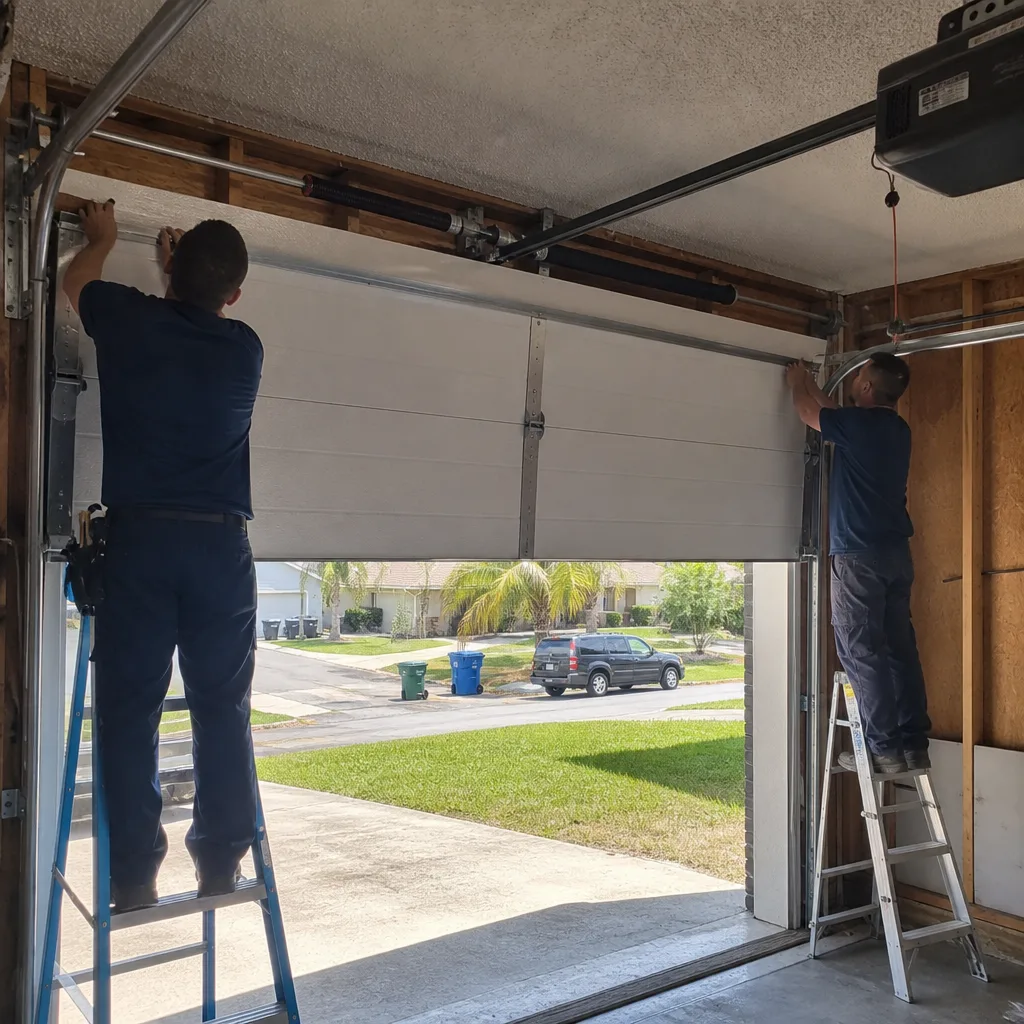
Homeowners use “slow” and “unbalanced” interchangeably, and they’re different conditions with different repair scopes and different price tags. Understanding which one you have saves money and time.
A slow door is a friction or opener problem
A door that moves smoothly but takes noticeably longer to open than it used to is fighting friction. The cause is almost always one of three things: rollers that need replacement, a track that needs lubrication or alignment, or an opener that’s nearing the end of its service life. The door closes correctly, holds position when disconnected, and passes the balance test. It just moves slower than it should. In our experience, most slow doors in Coral Springs are roller and track issues, and the repair is $120 to $250. Opener motor wear is the second most common cause, and that repair or replacement runs $250 to $450 for a belt-drive unit, including installation.
An unbalanced door is a spring problem
An unbalanced door may not be slow at all. With the opener disconnected, it drops or climbs on its own. The door is heavier on one side, or the springs have lost enough tension that they can no longer counterbalance the door’s weight. This is not a lubrication issue and it is not fixed by adjusting the opener’s force settings. The only correct repair is spring replacement, and the longer an unbalanced door is operated, the more secondary damage it causes to cables, hinges, and the opener itself. The cost range for spring replacement is $180 to $340 for a single spring and $300 to $550 for a pair, which is the standard configuration on double doors.
The distinction matters because a homeowner who self-diagnoses a slow door and spends $30 on lubricant for a door that’s actually unbalanced has lost a week and gained nothing. The balance test above is the differentiator. Run it, and you’ll know which problem you have before you make the call.
Opener Warning Signs: Clicking, Partial Operation, and Logic Board Failure
The opener is the most complicated component on the door, and its failure modes are more varied than the door’s. But two patterns show up repeatedly in Coral Springs service calls.
The clicking opener that won’t engage
You press the wall button or remote. The opener clicks. The motor doesn’t run. The click is the sound of the logic board or the relay trying to send power to the motor. If the motor doesn’t respond, the failure is usually the logic board or the run capacitor. The logic board is the green circuit board inside the opener head, and when it fails, the symptoms vary: clicking with no motor response, intermittent operation, opening but not closing, or responding to the wall button but not the remote. A logic board replacement is $150 to $250 on most LiftMaster and Chamberlain units, and that’s a repair we’d recommend before replacing the entire opener if the motor and gear are still in good condition.
Partial operation and the force-settings trap
An opener that opens but hesitates before closing, or closes but reverses near the bottom, is describing either a door problem or a settings problem. The homeowner solution is to adjust the force limit dials on the opener body, which can mask the underlying issue for a while. But cranking up the force limit to “fix” a door that’s gotten heavier is a fast track to a broken opener. Opener motors have a designed duty cycle and a designed force output. Exceeding the force output regularly, the way you do with an unbalanced door, converts a $300 spring job into a $600 spring and opener job. The fix is to correct the door’s balance and then set the force limits back to the manufacturer’s recommended settings.
Opener repair and replacement is a different discipline than door repair. If you’re in a position where the door moves freely on the manual test but the opener won’t operate it, the problem is in the opener. For a full breakdown of opener-specific symptoms and costs, see Garage Door Opener Repair & Installation in Coral Springs.
How Coral Springs Climate Accelerates Garage Door Wear
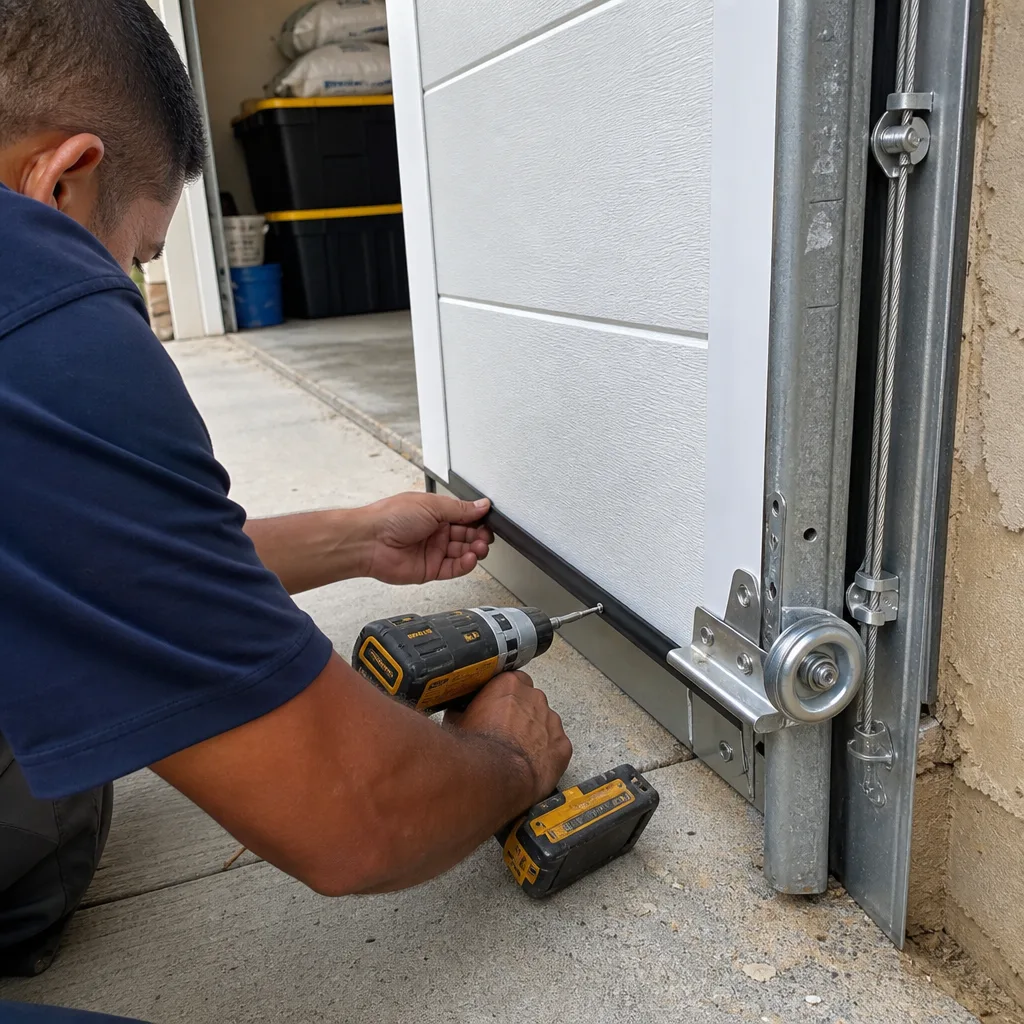
Coral Springs sits far enough from the ocean that salt air is less aggressive here than in coastal cities, but the humidity is relentless. And humidity is the variable that drives most of the accelerated wear patterns we see on garage doors in the area. Here’s what the climate does, component by component.
Springs rust faster in humid garages
Torsion springs are oil-tempered steel, and they rust. A spring in a humidity-controlled garage might last 10 to 12 years. A spring in a Coral Springs garage that isn’t climate controlled, which describes most of them, rusts through its protective oil coating faster, and rust shortens spring life by 30% or more. The rust creates pitting, and pitting creates stress concentrations, and stress concentrations create breaks. This is why spring replacement is a common repair in Coral Springs, and why the 8-to-10-year spring life range you’ll see in generic guides doesn’t always hold here.
Hardware expansion and contraction
Garage doors are metal structures that expand and contract with temperature changes, and Coral Springs cycles between hot, humid days and occasional sharp cold fronts. Those cycles work on the track bolts and hinge fasteners. Over years, the bolts loosen microscopically, the track shifts, and a door that tracked true begins to bind. The fix is usually track realignment and bolt tightening, a $100 to $200 repair that restores smooth operation. The prevention is an annual service visit that checks fasteners, which most homeowners skip.
Wood and composite doors respond to humidity differently
Solid wood doors, common on older Coral Springs homes, absorb moisture and expand. Composite doors, common on newer builds, are more stable but still respond to humidity cycles. When a wood door swells, it can bind against the track, creating exactly the kind of force-limit reversal described earlier. We see this with Wayne Dalton and Amarr wood doors that are fine in winter and problematic in August. The answer isn’t opener adjustment; it’s managing the door’s clearance and, in some cases, planning for panel replacement as the wood loses dimensional stability.
Understanding the climate factor changes how you read warning signs. A door that reverses in August and works fine in January is telling you something about water absorption, not about sensor alignment. That’s a Coral Springs-specific signal, and it’s the kind of detail that separates a useful diagnosis from a generic guess.
Documentation Before You Call: Why Photos Change the Quote
Here’s a practice that changes the economics of garage door repair, and it takes five minutes. Before you call a technician, photograph the warning sign. The rust at the bottom bracket. The popped spring. The chipped panel. The white oxidation on the track. The video of the door reversing mid-travel. The sound recording of the grinding.
This matters for three reasons. First, it gives the technician a baseline. When our technicians arrive at a home in Coral Springs, they start by assessing the door’s condition, and the customer who can show us what the problem looked like yesterday gives us a reference point that a current inspection can’t provide. A cable that’s frayed today was less frayed a week ago, and the photo tells us how fast the failure is progressing.
Second, it prevents scope creep. The repair industry has a reputation problem, and the only reliable cure is evidence. A customer who can say “here’s what I saw on Tuesday” is a customer who’s already protected against a diagnosis that exceeds the evidence. We’ve built this into our own process. Clause 4 of The Haven Standard, the documentation system we operate under, requires our technicians to photograph the failed component before quoting a replacement. You see the broken spring. You see the rust on the bracket. You see the scored track. The photo is the justification for the price, and it’s delivered to you as part of the service record.
Third, documentation speeds up the call. A homeowner who emails or texts photos before the visit gives us the chance to bring the right parts on the first trip. That’s the difference between a same-visit repair and a follow-up appointment, and in Coral Springs, where a door that’s stuck open is also a security problem, the faster the repair, the better.
The documentation habit is compatible with how modern homeowners operate. You’re already taking photos. Point the phone at the garage door before you call.
Common Mistakes to Avoid
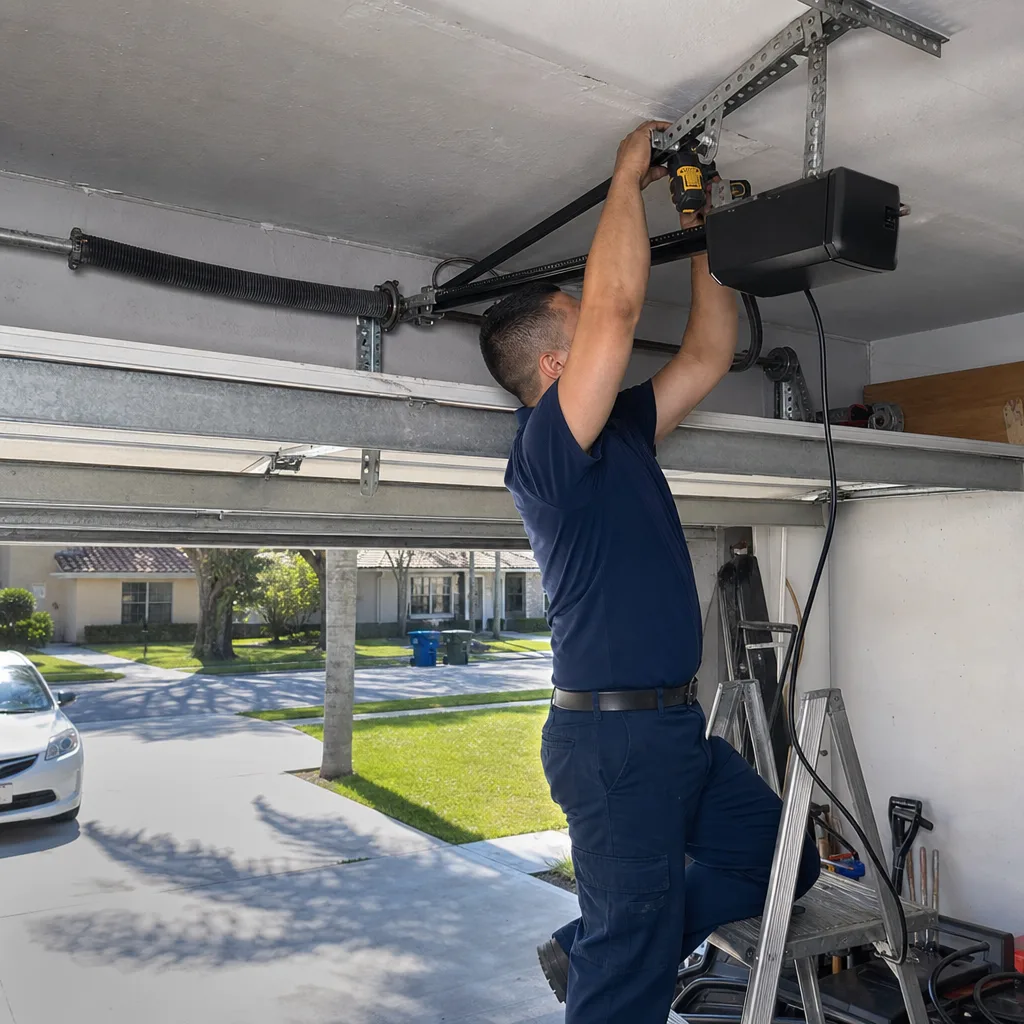
- Lubricating a door that’s actually unbalanced. Lubricant fixes friction. It doesn’t fix spring tension. If the door fails the balance test, no amount of spray lubricant will help, and the continued operation of the door while you wait for the lubricant to work accelerates spring wear.
- Adjusting the opener’s force limits to fix a heavy door. The force limit dial exists to tune the opener’s obstruction sensitivity, not to compensate for a door that’s gained weight. Cranking it up is the most reliable way to burn out an opener motor, and it’s a self-inflicted $300 repair on top of the spring repair you still need.
- Ignoring popping sounds from the spring area. A popping torsion spring is a pre-failure indicator. The spring is announcing that it’s about to break. A broken spring means the door won’t open, and if it breaks while the door is open, the door can slam shut with enough force to damage the door panels or injure anyone underneath it.
- Continuing to operate a door with rusted cables. Cables under tension don’t fail gracefully. A cable that snaps while the door is in motion releases stored spring energy unpredictably. In Coral Springs garages, where spaces are tighter, there’s less room for a cable to lash and less room to get out of the way.
- Replacing the opener when the door is the problem. An opener that reverses, struggles, or runs briefly and stops is frequently reacting to a door problem, not an opener problem. Replacing the opener without fixing the door’s weight or alignment installs a fresh opener into the same conditions that shortened the old one’s life.
- Treating a bowed panel as a cosmetic issue. Bowed panels affect weight distribution, which affects spring wear, which affects opener load. On wood and composite doors in Coral Springs, a bowed panel is a functional problem, and it’s cheaper to address one panel than to replace the door after the misalignment damages tracks and cables.
When to Call a Professional
Some repairs are safe and reasonable for a homeowner who’s comfortable with basic maintenance: lubricating hinges, tightening loose bolts, checking sensor alignment. But any of the following conditions warrants a professional call in Coral Springs. If you’re unsure whether to DIY, check out How to Hire a Garage Door Contractor in Coral Springs: A Step-by-Step Guide.
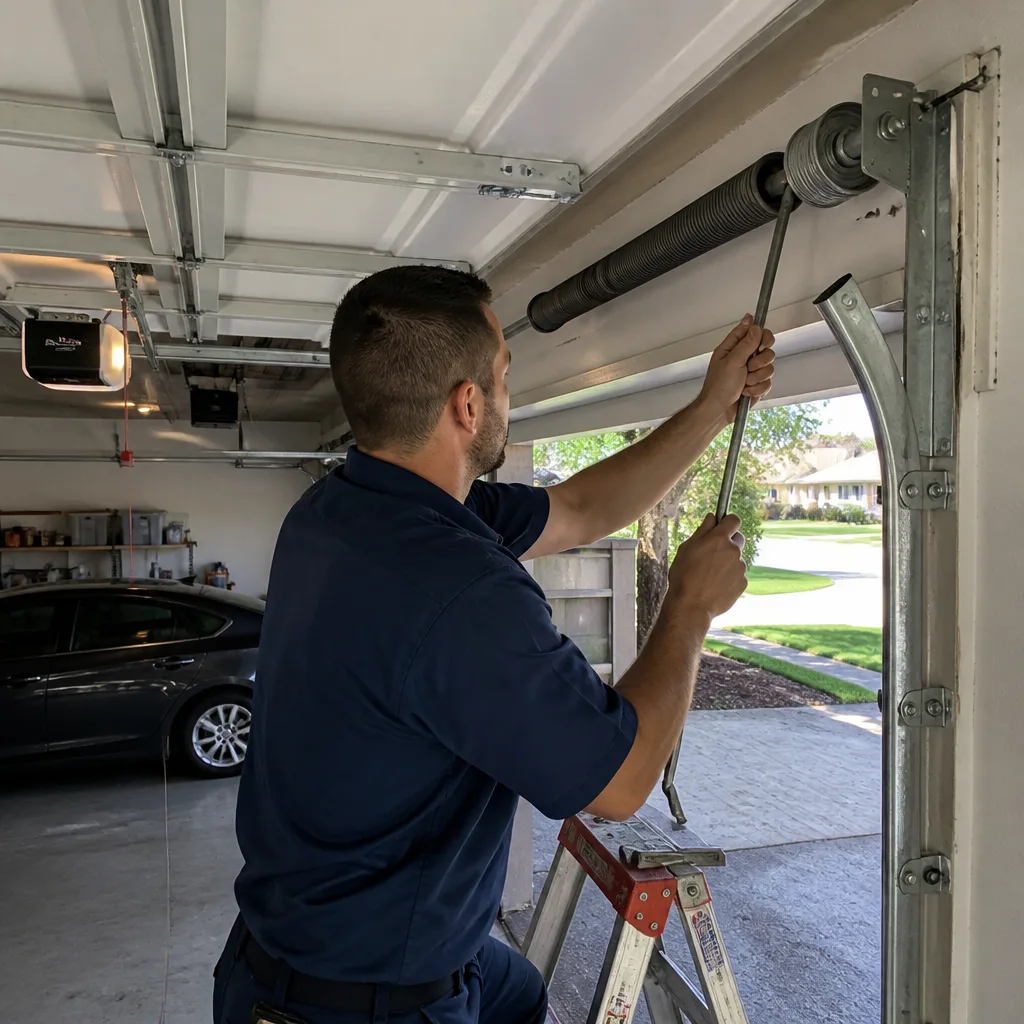
- Popping, broken, or visibly rusted springs. Torsion springs are under extreme tension, and DIY spring replacement is the leading cause of serious garage door injuries. This is not a maintenance task.
- Frayed or rusted cables, especially at the bottom bracket. Cable failure is unpredictable and dangerous, and the repair requires removing the spring tension safely.
- A door that fails the balance test. Spring replacement requires specialized winding bars and an understanding of the spring’s torque requirements.
- An opener that clicks without engaging, or any opener symptom that persists after the door itself passes the balance test. Logic board and motor diagnosis involves live voltage.
- Track misalignment or scoring that’s visible to the eye. Track repair often requires partial disassembly of the door, and realigning tracks improperly can cause a door to come off its track entirely.
Servo Garage Doors Coral Springs offers free estimates in Coral Springs, and every estimate is a flat, written price with a written scope before any work begins. Call (754) 399-3666. We photograph the failed component before we quote the replacement, so the price has evidence behind it. For homeowners considering a replacement rather than a repair, we also provide Garage Door Installation in Coral Springs with the same written-price system.
Frequently Asked Questions
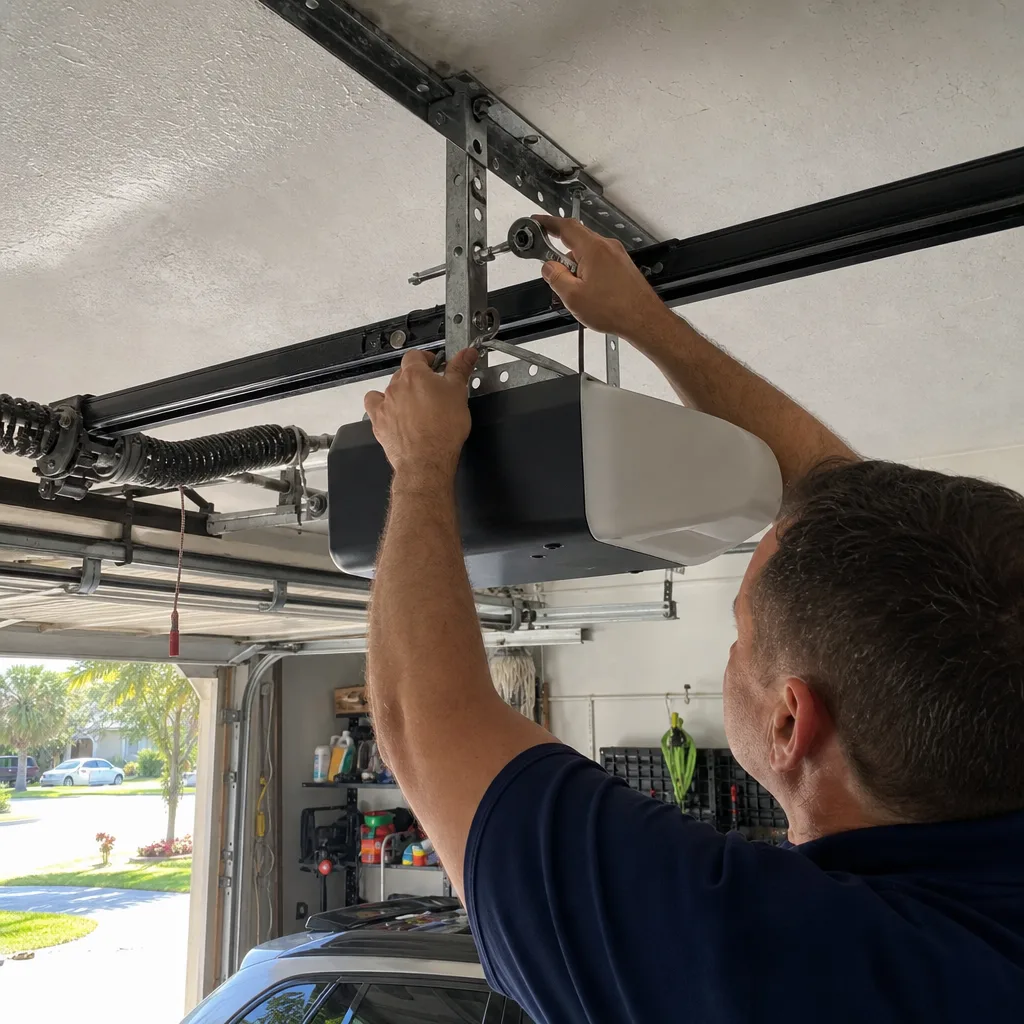
Most garage door repairs in Coral Springs fall between $120 and $550 depending on the component. Roller replacement typically runs $120 to $180 for a full set. Single torsion spring replacement is $180 to $340, and a spring pair is $300 to $550. Cable replacement is $150 to $250. Logic board replacement on most LiftMaster and Chamberlain openers is $150 to $250. Track realignment is $100 to $200. The price is quoted and agreed before any work starts, and at Servo Garage Doors Coral Springs the quote is a flat, written price per Clause 1 of The Haven Standard. Call (754) 399-3666 for an exact quote.
Yes. We carry the most common repair components on the truck: springs, cables, rollers, hinges, and logic boards for LiftMaster, Chamberlain, Genie, and other major brands. A repair that doesn’t require special-order parts is typically completed on the first visit. Call (754) 399-3666 and describe the symptom; a live person answers 24/7, and we’ll tell you what we can do the same day.
A door that reverses mid-travel is either a sensor alignment issue, a door that’s become too heavy (often from humidity-related swelling in Coral Springs), or a failing opener logic board. The fastest diagnostic is the manual balance test: disconnect the opener with the red emergency cord and lift the door by hand. If it feels heavy or drops, the door’s weight is the problem and the opener is correctly reversing under excess load. If the door lifts easily and stays put, check sensor alignment, then suspect the opener.
In Coral Springs’s humid climate, torsion springs typically last 7 to 10 years, somewhat less than the 10-to-12-year range common in drier climates. Humidity accelerates rust on the spring’s surface, which creates pitting and shortens the spring’s fatigue life. A spring that’s nearing the end of its life will show visible rust, may pop during operation, and will eventually fail the balance test. If your door is in that age range and shows these signs, replacement is more cost-effective than waiting for a break.
A slow door moves smoothly but takes longer to travel, and the cause is friction: worn rollers, a dry or misaligned track, or a weakening opener motor. An unbalanced door drops or rises on its own when disconnected from the opener, and the cause is worn or broken springs. Slow doors are $120 to $450 to repair depending on the component. Unbalanced doors require spring replacement, $180 to $340 for a single spring or $300 to $550 for a pair. The balance test tells you which condition you have.
Yes. Photos of the rust, the broken part, the panel damage, or a video of the door misbehaving give the technician a reference point that prevents misdiagnosis and scope creep. At Servo Garage Doors Coral Springs, documentation is built into the service. Clause 4 of The Haven Standard requires the technician to photograph the failed component before quoting a replacement, and the customer receives that photo as part of the service record. The habit of documenting is cheap insurance, and it makes the repair conversation faster and more accurate.
The Bottom Line
A garage door warns you before it fails. The noise has a source. The rust has a pattern. The reversal has a reason. Learning to read those signals, instead of living with them, is the difference between a $150 roller replacement and a $550 spring and cable repair, between a working opener and a burned-out motor, between a door that opens every morning and one that doesn’t. In Coral Springs, the humidity accelerates these failures and makes early detection more valuable. Run the balance test. Photograph what you find. Get a written price before any work begins. Call (754) 399-3666 for a free estimate, and if you’d prefer to understand your options before scheduling, start with Servo Garage Doors Coral Springs home for a full breakdown of how we work.
Written by Marcus Deller, Owner at Servo Garage Doors Coral Springs, serving Coral Springs since 2015.